Skip to content

Canada Elections Act

S.C. 2000, c. 9

In forceCurrent to September 30, 2026 History

Loading…

Schedules

SCHEDULE 1

FORM 1(Section 58)Writ of Election

Deputy of the Governor General

ELIZABETH THE SECOND, by the Grace of God of the United Kingdom, Canada and Her other Realms and Territories QUEEN, Head of the Commonwealth, Defender of the Faith.

To

of

GREETING:

WHEREAS, by and with the advice of OUR PRIME MINISTER OF CANADA, We have ordered a PARLIAMENT TO BE HELD AT OTTAWA, on the day of next. (Omit the foregoing preamble in case of a by-election.)

WE COMMAND YOU that, notice of the time and place of election being duly given,

YOU DO CAUSE election to be made according to law of a member to serve in the House of Commons of Canada for the said electoral district in the Province aforesaid (in case of a by-election: in the place of );

AND YOU DO CAUSE the closing day for the nomination of candidates to be ;

And if a poll becomes necessary, that the poll be held on ;

AND YOU DO CAUSE the name of that member when so elected, whether present or absent, to be certified to Our Chief Electoral Officer, as by law directed (in case of a by-election, omit the following) as soon as possible and not later than the day of (year).

Witness:, Deputy of Our Right Trusty and Well-beloved , Chancellor and Principal Companion of Our Order of Canada, Chancellor and Commander of Our Order of Military Merit, GOVERNOR GENERAL AND COMMANDER-IN-CHIEF OF CANADA.

At Our City of , on and in the year of Our Reign.

BY COMMAND,

Chief Electoral Officer

FORM 2(Section 62)

Notice of Election form

FORM 3(Subsections 116(1) and 138(1))Form of Ballot Paper

Front

Front view of form of ballot paper with sample names and white circles next to each name all on a black background

FORM 3 – ConcludedForm of Ballot Paper

Back
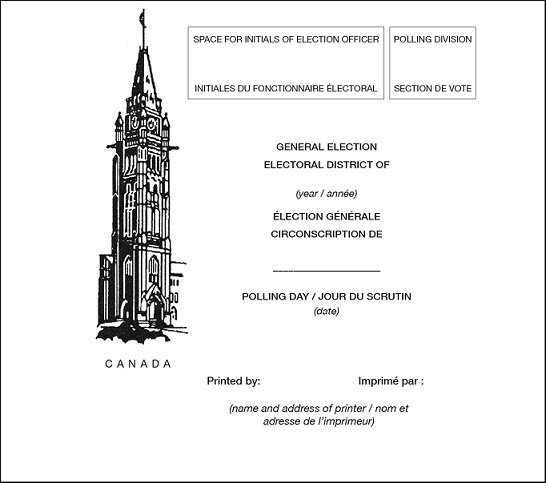
Back view of form of ballot paper

FORM 4(Section 186)Form of Special Ballot Paper

Form of special ballot paper
  • 2000, c. 9, Sch. 1
  • 2018, c. 31, s. 375
.

SCHEDULE 2(Section 46)

Provincial Acts

  • Alberta
    • Election Act, R.S.A. 2000, c. E-1
    • Traffic Safety Act, R.S.A. 2000, c. T-6
    • Vital Statistics Act, S.A. 2007, c. V-4.1
  • British Columbia
    • Election Act, R.S.B.C. 1996, c. 106
    • Motor Vehicle Act, R.S.B.C. 1996, c. 318
    • Vital Statistics Act, R.S.B.C. 1996, c. 479
  • Manitoba
    • The City of Winnipeg Charter Act, S.M. 2002, c. 39
    • The Drivers and Vehicles Act, C.C.S.M. c. D104
    • The Elections Act, S.M. 2006, c. 15, Sch. A
    • The Highway Traffic Act, S.M. 1985-86, c. 3
    • The Municipal Councils and School Boards Elections Act, S.M. 2005, c. 27
    • The Vital Statistics Act, R.S.M. 1987, c. V60
  • New Brunswick
    • Elections Act, R.S.N.B. 1973, c. E-3
    • Motor Vehicle Act, R.S.N.B. 1973, c. M-17
    • Vital Statistics Act, S.N.B. 1979, c. V-3
  • Newfoundland and Labrador
    • Elections Act, 1991, S.N.L. 1992, c. E-3.1
    • Highway Traffic Act, R.S.N.L. 1990, c. H-3
    • Vital Statistics Act, S.N.L. 2009, c. V-6.01
  • Northwest Territories
    • Elections and Plebiscites Act, S.N.W.T. 2006, c. 15
    • Motor Vehicles Act, R.S.N.W.T. 1988, c. M-16
    • Vital Statistics Act, S.W.N.T. 2011, c. 34
  • Nova Scotia
    • Elections Act, S.N.S. 2011, c. 5
    • Motor Vehicle Act, R.S.N.S. 1989, c. 293
    • Vital Statistics Act, R.S.N.S. 1989, c. 494
  • Nunavut
    • Motor Vehicles Act, R.S.N.W.T. 1988, c. M-16, as duplicated for Nunavut by section 29 of the Nunavut Act, S.C. 1993, c. 28
    • Nunavut Elections Act, S.Nu. 2002, c. 17
    • Vital Statistics Act, R.S.N.W.T. 1988, c. V-3, as duplicated for Nunavut by section 29 of the Nunavut Act, S.C. 1993, c. 28
  • Ontario
    • Election Act, R.S.O. 1990, c. E.6
    • Highway Traffic Act, R.S.O. 1990, c. H.8
    • Municipal Elections Act, 1996, S.O. 1996, c. 32, Sched.
    • Vital Statistics Act, R.S.O. 1990, c. V.4
  • Prince Edward Island
    • Election Act, R.S.P.E.I. 1988, c. E-1.1
    • Highway Traffic Act, R.S.P.E.I. 1988, c. H-5
    • Vital Statistics Act, R.S.P.E.I. 1988, c. V-4.1
  • Québec
    • Civil Code of Québec, S.Q. 1991, c. 64
    • Election Act, R.S.Q., c. E-3.3
    • Highway Safety Code, R.S.Q., c. C-24.2
  • Saskatchewan
    • The Election Act, 1996, S.S. 1996, c. E-6.01
    • The Traffic Safety Act, S.S. 2004, c. T-18.1
    • The Vital Statistics Act, S.S. 2009, c. V-7.21
  • Yukon
    • Elections Act, R.S.Y. 2002, c. 63
    • Motor Vehicles Act, R.S.Y. 2002, c. 153
    • Vital Statistics Act, R.S.Y. 2002, c. 225

Other Sources of Information

  • Canada Post Corporation’s National Change of Address Database
  • Immigration, Refugees and Citizenship Canada
  • Info-directTM
  • Public Curator (Quebec)
  • 2000, c. 9, Sch. 2
  • Canada Gazette Part I, Extra Volume 134, Nos. 6, 8
  • Canada Gazette Part I, Extra Volume 135, No. 1
  • 2002, c. 7, s. 95
  • Canada Gazette Part I, Volume 137, page 685
  • Canada Gazette Part I, Volume 138, pages 283, 976, 1329
  • Canada Gazette Part I, Volume 140, page 3630
  • Canada Gazette Part I, Volume 142, pages 2159 to 2161
  • Canada Gazette Part I, Volume 148, page 623
  • Canada Gazette Part I, Volume 153, page 1248
.

Amended on September 16, 2026

SCHEDULE 3(Paragraphs 66(1)(e) and (f) and section 539)List of Electoral Districts

  • Province of Ontario
    • Kapuskasing — Timmins — Mushkegowuk
    • Kenora — Kiiwetinoong
    • Sault Ste. Marie — Algoma
    • Sudbury East — Manitoulin — Nickel Belt
    • Thunder Bay — Rainy River
    • Thunder Bay — Superior North
  • Province of Quebec
    • Abitibi — Baie-James — Nunavik — Eeyou
    • Abitibi — Témiscamingue
    • Côte-Nord — Kawawachikamach — Nitassinan
  • Province of Manitoba
    • Churchill — Keewatinook Aski
    • Riding Mountain
  • Province of British Columbia
    • Cariboo—Prince George—Omineca
    • Kamloops — Thompson — Nicola
    • North Island — Powell River
    • Prince George — Peace River — Northern Rockies
    • Skeena — Bulkley Valley
  • Province of Saskatchewan
    • Battlefords — Lloydminster — Meadow Lake
    • Desnethé — Missinippi — Churchill River
    • Prince Albert
    • Yorkton — Melville
  • Province of Alberta
    • Fort McMurray — Cold Lake
    • Grande Prairie
    • Lakeland
    • Peace River — Westlock
    • Yellowhead
  • Province of Newfoundland and Labrador
    • Coast of Bays—Central—Notre Dame
    • Labrador
    • Long Range Mountains
  • Yukon
    • Yukon
  • Northwest Territories
    • Northwest Territories
  • Nunavut
    • Nunavut

[Note: Names of electoral districts may change before Schedule 3 is officially amended. For the most up-to-date list, see the Schedule 3 profile page on Elections Canada’s website at this link:

https://www.elections.ca/content.aspx?section=res&dir=loi%2Ffel%2Fs3&document=index&lang=e ]

  • 2000, c. 9, Sch. 3
  • 2002, c. 7, s. 95
  • Canada Gazette Part I, Extra Volume 138, No. 5
  • Canada Gazette Part I, Extra Volume 149, No. 2
  • 2018, c. 31, s. 376
  • Canada Gazette Part I, Extra Volume 159, No. 4
  • 2026, c. 20, s. 88.1
  • 2026, c. 20, s. 88.2
.

SCHEDULE 4(Subsection 304(3))

Procedure for Recounts

Persons Who May Be Present

  • 1 Only the following persons may be present during the recount in addition to the judge, the returning officer and the staff that the returning officer asks to assist in the recount and the recount teams:

    • (a) the candidates;

    • (b) up to two representatives for each candidate who are not members of a recount team;

    • (c) one legal counsel for each candidate;

    • (d) legal counsel for the Chief Electoral Officer; and

    • (e) any other person that the judge allows.

  • 2 Persons referred to in paragraph 1(e) may observe the conduct of the recount but shall not participate. They may bring any concerns they have to the attention of the returning officer who shall relay them to the judge. The judge shall take any measure that he or she considers appropriate.

Recount Teams

  • 3 The judge shall, with the Chief Electoral Officer’s approval, establish an appropriate number of recount teams, each consisting of two members appointed by the returning officer — one to have the responsibilities of handler and the other those of recorder — and one representative appointed by each candidate who wishes to be represented on the recount team. Each team is to be assigned a sequential team number, beginning with 1.

Process — General

  • 4 Each recount team shall be assigned to a table and shall remain at its table except during breaks as directed by the judge. To the extent practical, these breaks shall commence only after the recount of a particular ballot box has been completed.

  • 5 The functions of a recount team are the following:

    • (a) to examine the ballots in any ballot box assigned to it to ascertain whether the team agrees on their classification;

    • (b) to set aside for examination by the judge any ballots on whose classification there is not agreement (“disputed ballot”); and

    • (c) to count and report the number of ballots in each classification.

  • 6 At any time during the recount, the candidates referred to in paragraph 1(a) may consent to having the judge conduct the recount by adding the number of votes reported in the statements of the vote, instead of the counting of ballots.

  • 7 (1) The returning officer shall assign ballot boxes to recount teams throughout the recount in a manner that promotes the efficient and continuous counting of ballots, having regard to the number of ballots in each ballot box.

    • (2) A ballot box shall not be assigned to a recount team if the handler or the recorder of that team was assigned to the advance polling station or polling station from which the box originated.

  • 8 Ballots cast under Part 11 of this Act shall be assigned to recount teams 1 to 3. The process set out in sections 10 to 18 shall be followed with any necessary modifications with regard to envelopes containing ballots cast under that Part. No other ballots or ballot boxes shall be assigned to those teams until the recount of those ballots has been completed.

  • 9 Only the handler or the recorder of a recount team shall handle a ballot box or an envelope containing ballots that is assigned to his or her recount team or any other document or other election material that is in or accompanies the box or envelope.

Process — for Each Ballot Box

  • 10 When a ballot box and the corresponding original statement of the vote are delivered to a recount team,

    • (a) the recorder shall note the number of the ballot box on the Recount Ballot Box Report in the prescribed form; and

    • (b) the handler shall open the ballot box, remove and open the large envelope referred to in subsection 288(3) of this Act and remove from it the envelopes containing ballots.

  • 11 (1) The recount team shall examine the envelopes containing spoiled ballots and unused ballots without opening them.

    • (2) If there is any dispute concerning one of those envelopes or a request that one of them be opened, the question shall be determined by the judge.

  • 12 The recount team shall recount first the ballots in the envelope containing the rejected ballots, if any — according to the criteria referred to in section 269, 279, 284 or 285 of this Act — and then, envelope by envelope in alphabetical order of the candidates’ names, the ballots that were classified as valid votes in favour of candidates.

For Each Envelope — Review of Ballots

  • 13 The recount of the ballots from each of those envelopes shall be conducted in accordance with the following steps:

    • (a) the handler shall choose the appropriate envelope;

    • (b) if any ballots were placed with that envelope as a result of the earlier examination of another envelope, the handler shall place those ballots in a single pile (the “counting pile”);

    • (c) the handler shall unseal the envelope and, taking the first of those ballots,

      • (i) if a counting pile has already been established, place it on the counting pile, and

      • (ii) if no counting pile has yet been established, establish one with that first ballot;

    • (d) the handler shall invite all members of the recount team to examine — but not handle — the ballot;

    • (e) the handler shall ascertain whether there is unanimous agreement in the recount team that the ballot

      • (i) was correctly classified, or

      • (ii) should be assigned to some other classification;

    • (f) if there is no unanimous agreement, each representative of a candidate is entitled to call for one of their candidate’s representatives who is not a member of a recount team or their candidate’s legal counsel, or both, who may then make representations to the team;

    • (g) if, after any such representations, there is still no unanimous agreement on the classification of the ballot, the ballot shall be treated as a disputed ballot, in which case

      • (i) the handler shall take the ballot from the counting pile, print on the back of the ballot (with the pen or pencil supplied to the recount team in small but legible script), a number in the form “XX-Y” where “XX” is the ballot box number and “Y” is a unique sequential number starting at “1” for each disputed ballot within that box,

      • (ii) the recorder shall make an entry for the disputed ballot in the register of disputed ballots in the Recount Ballot Box Report, indicating its number and the envelope from which it originated, and

      • (iii) the handler shall put the disputed ballot with an additional envelope marked “disputed ballots”;

    • (h) if there is unanimous agreement that the ballot was correctly classified, it shall remain on the counting pile;

    • (i) if there is unanimous agreement that the ballot should be assigned to some other classification, the handler shall take it from the counting pile and

      • (i) if the envelope containing ballots of that other classification has not yet been recounted, the handler shall place the ballot with that envelope and the recorder shall note the re-classification of the ballot and the reason for it on the Recount Ballot Box Report, and

      • (ii) if the envelope containing ballots of that other classification has already been recounted, the handler shall place the ballot in that envelope and the recorder shall note the re-classification of the ballot and the reason for it on the Recount Ballot Box Report and adjust the number of ballots recorded in the report for that other classification accordingly;

    • (j) for each subsequent ballot in the envelope, the handler shall place it on top of the counting pile, and steps (d) to (i) apply with respect to it; and

    • (k) when all ballots from the envelope have been examined by the team, the handler shall count the ballots in the counting pile, the recorder shall make a note of that number on the Recount Ballot Box Report and the handler shall place those ballots in the envelope without sealing it.

Preparation for Return of Ballot Box

  • 14 (1) When all envelopes from the ballot box — except those designated as containing spoiled ballots and unused ballots — have been recounted, if there are any disputed ballots,

    • (a) the handler shall count the disputed ballots and place them in the disputed ballots envelope and indicate the number of the corresponding ballot box on the envelope;

    • (b) the recorder shall note the number of disputed ballots on the Recount Ballot Box Report, confirm the accuracy of the report with the recount team, invite the candidates’ representatives to initial it and attach it to the disputed ballots envelope together with the corresponding original statement of the vote; and

    • (c) the handler shall not seal the envelope containing rejected ballots, if any, or the envelopes for each candidate, and shall place the envelopes, including the unsealed disputed ballots envelope, in the ballot box along with the Recount Ballot Box Report, the corresponding original statement of the vote and the large envelope.

    • (2) However, if there are no disputed ballots,

      • (a) the handler shall seal the envelope containing rejected ballots, if any, and the envelopes for each candidate and place them in the ballot box;

      • (b) the recorder shall confirm the accuracy of the Recount Ballot Box Report with the recount team, invite the candidates’ representatives to initial it, and give it to the handler; and

      • (c) the handler shall place the Recount Ballot Box Report, the corresponding original statement of the vote and the large envelope in the ballot box.

    • (3) When the actions in subsection (1) or (2) have been completed, the handler shall signal by raised hand that the recount team has completed its work with that ballot box.

Return of Ballot Box

  • 15 A person designated by the returning officer from among his or her staff shall bring the recount team another ballot box and shall take the recounted ballot box from the recount team and deliver it to the returning officer.

  • 16 On receipt of a recounted ballot box, the returning officer shall ascertain whether it contains a disputed ballots envelope.

If There Are No Disputed Ballots

  • 17 (1) If the ballot box does not contain a disputed ballots envelope, the returning officer shall provide the Recount Ballot Box Report and attached original statement of the vote to the judge.

    • (2) The judge shall review the report and statement and, if satisfied, shall initial the report to indicate his or her approval.

    • (3) If the judge approves the report, the returning officer shall cause the sealed envelopes to be placed in the large envelope, the large envelope to be sealed and placed in the ballot box, the ballot box to be sealed and placed in a secure location designated for ballot boxes for which the recount has been completed and the report and statement to be given to the person responsible for the preparation of the Master Recount Report.

    • (4) If the judge does not approve the report, the judge shall determine how to proceed with the ballot box.

If There Are Disputed Ballots

  • 18 If the ballot box contains a disputed ballots envelope, the judge shall cause it to be dealt with in accordance with the following steps:

    • (a) photocopies of the front and back of each disputed ballot in the disputed ballots envelope shall be made — one for each party referred to in paragraphs 1(a) to (c), as the case may be, and one for the judge. Then the disputed ballot shall be returned to the disputed ballots envelope;

    • (b) after step (a) is completed for all the disputed ballots, the disputed ballots envelope shall be returned to the ballot box;

    • (c) the judge shall then set a time for the determination of the classification of the disputed ballots. Before the judge makes a determination with respect to a disputed ballot, each party may make submissions. Unless the judge decides otherwise, for the purpose of making submissions, any party opposing the original classification of the ballot will be considered an applicant, and all other parties will be considered respondents;

    • (d) the judge shall, in the Recount Ballot Box Report, indicate in writing the determination with respect to each disputed ballot and complete the judge’s disposition portion of the report;

    • (e) the judge shall cause each ballot for which a determination of classification has been made to be placed into the appropriate envelope corresponding to the determination, and shall cause the envelopes to be sealed and placed in the large envelope and the large envelope to be sealed and placed in the ballot box;

    • (f) the judge shall cause the ballot box and its contents to be sealed and placed in a secure location designated for ballot boxes for which the recount has been completed; and

    • (g) the judge shall sign the Recount Ballot Box Report, which shall be given, with the judge’s disposition noted on it, to the person responsible for the preparation of the Master Recount Report along with the original statement of the vote.

Master Recount Report and Certificate of Votes

  • 19 A person designated by the judge shall transfer the final results shown on the Recount Ballot Box Reports onto the Master Recount Report.

  • 20 Each of the parties referred to in paragraphs 1(a) to (c), as the case may be, and the returning officer shall have the opportunity, from time to time and at the conclusion of the preparation of the Master Recount Report, to inspect and compare the Recount Ballot Box Reports and the Master Recount Report, and to bring any error or discrepancy noted to the attention of the judge.

  • 21 When the recount is complete, the parties referred to in paragraphs 1(a) to (c), as the case may be, may make their final submissions to the judge with respect to the accuracy of the Master Recount Report and the judge shall determine any issues arising from those submissions and ensure that the Master Recount Report is completed in accordance with any such determination.

  • 22 The judge shall — on the basis of the Master Recount Report — without delay prepare a certificate in the prescribed form that sets out the number of votes cast for each candidate and deliver the original of the certificate to the returning officer and a copy of it to each of the parties referred to in paragraphs 1(a) to (c), as the case may be.

Other Powers of the Judge

  • 23 The judge may alter these procedures during the recount after giving the parties referred to in paragraphs 1(a) to (c), as the case may be, and the returning officer the opportunity to make submissions.

  • 24 Any matter not dealt with in these procedures, and any question arising as to the application of these procedures, is to be determined by the judge, including whether persons referred to in section 1 are permitted to communicate with the media.

  • 2014, c. 12, s. 126
  • 2018, c. 31, s. 377
.

RELATED PROVISIONS

  • — 2003, c. 19, s. 65

    • Prior contributions

      65 A contribution made before the coming into force of this section shall not be taken into account for the purposes of subsections 404.1(1) and 405(1) of the Canada Elections Act, as enacted by this Act.

  • — 2003, c. 19, s. 66

    • Coming into force during an election period
      • 66 (1) If this section comes into force during an election period, the Canada Elections Act, as it read immediately before the coming into force of this section, applies with respect to that election and all related obligations and rights including obligations to report and rights to reimbursement of election expenses.

      • Prior elections

        (2) For greater certainty, the Canada Elections Act, as it read immediately before the coming into force of this section, applies with respect to any election that preceded the coming into force of this section and to all related obligations or rights including obligations to report and rights to reimbursement of election expenses.

  • — 2003, c. 19, s. 67

    • Coming into force during a leadership contest

      67 If this section comes into force during a competition for the selection of the leader of a registered party, the Canada Elections Act, as amended by this Act, does not apply with respect to that competition.

  • — 2003, c. 19, s. 68

    • Suspended party

      68 A political party whose registration is suspended immediately before this section comes into force is deregistered on the day on which it comes into force. The Canada Elections Act, as amended by this Act, applies with respect to the deregistration.

  • — 2003, c. 19, s. 69

    • Financial reporting — registered parties
      • 69 (1) Despite section 66, for the fiscal period of a registered party during which this section comes into force,

        • (a) sections 424 to 427 and 429 to 431 of the Canada Elections Act, as amended by this Act, apply in respect of the documents that the registered party must provide in relation to that fiscal period; and

        • (b) with respect to contributions accepted by a registered party during that fiscal period and before the coming into force of this section, subsection 424(2) shall apply as if paragraphs 424(2)(a) to (c.1) of the Canada Elections Act, as they read immediately before the coming into force of this section, continued to be in force except that paragraph 424(2)(c) shall be applied without regard to the words “for its use, either directly or through one of its electoral district associations or a trust fund established for the election of a candidate endorsed by the registered party”.

      • Prior fiscal period

        (2) Sections 424 to 428 of the Canada Elections Act, as they read immediately before the coming into force of this section, apply with respect to the documents that a registered party must provide in relation to any fiscal period ending before the coming into force of this section.

  • — 2003, c. 19, s. 70

    • Electoral campaign return of candidate

      70 For the electoral campaign return of a candidate filed after this section comes into force,

      • (a) sections 451 to 456 of the Canada Elections Act, as amended by this Act, apply; and

      • (b) with respect to contributions accepted by a candidate before the coming into force of this section, subsection 451(2) shall apply as if paragraphs 451(2)(f) to (h.1) of the Canada Elections Act, as they read immediately before the coming into force of this section, continued to be in force except that paragraph 451(2)(h) shall be applied without regard to the words “either directly or through a registered party that endorses the candidate or through one of its trust funds, a trust fund established for the election of the candidate or an electoral district association”.

  • — 2003, c. 19, s. 71

    • Proportionate allowance
      • 71 (1) For the quarter during which this section comes into force, the allowance payable to a registered party under section 435.02 of the Canada Elections Act, as enacted by this Act, shall be proportionate to that part of the quarter during which that section is in force.

      • Advance payment

        (2) The allowance payable to a registered party under section 435.02 of the Canada Elections Act, as enacted by section 40 of this Act, for the quarter during which this section comes into force and for any remaining quarters of the year during which it comes into force shall be estimated on the basis of the most recent general election preceding the coming into force of this section and paid within 30 days after its coming into force. Subsection 435.02(2) of the Canada Elections Act, as enacted by this Act, applies to that payment with any modifications that may be required.

      • Advance payment to be taken into account

        (3) In the application of sections 435.01 and 435.02 of the Canada Elections Act, as enacted by this Act, any amount paid under subsection (2) in relation to a quarter shall be taken into account. A registered party that received an amount under subsection (2) for a quarter that is in excess of the amount to which it is entitled under those sections for that quarter shall without delay return to the Receiver General the amount of that excess. The Receiver General may reduce any other amount payable to the party by the amount of that excess.

  • — 2003, c. 19, s. 72

    • Next general election

      72 For the first general election after the coming into force of this section, the reference to “50%” in subsection 435(1) of the Canada Elections Act, as enacted by this Act, shall be read as a reference to “60%”.

  • — 2004, c. 24, s. 25

    • Parties to perfect registration
      • 25 (1) A party that is registered or eligible to become registered on the day on which this Act comes into force shall, within six months after that day, provide to the Chief Electoral Officer the information described in paragraphs 366(2)(d), (f), (i) and (j) of the Canada Elections Act, as enacted by this Act.

      • Requirements do not apply

        (2) Subsection 369(2), section 374.1, paragraph 377(2)(b.1), sections 378 and 380.1 and subsections 382(4) and 384(3) of the Canada Elections Act, as enacted by this Act, do not apply — until six months after the day on which this Act comes into force — in respect of a party that is registered or eligible to become registered on that day.

      • Requirements continue to apply

        (3) Subsection 369(2), section 378 and subsection 382(4) of the Canada Elections Act, as they read immediately before the day on which this Act comes into force, continue to apply — until six months after that day — in respect of a party that is registered or eligible to become registered on that day.

  • — 2004, c. 24, s. 26, as amended by 2006, c. 1, s. 1

    • Review

      26 Within two years after the coming into force of this section, the committee of the Senate that normally considers electoral matters, and the committee of the House of Commons that normally considers electoral matters, shall each undertake a comprehensive review of the amendments made by this Act and submit a report to its House containing its recommendations concerning those amendments.

  • — 2006, c. 9, s. 60

    • Transitional — Registered associations

      60 Sections 403.35 and 403.36 of the Canada Elections Act, as they read immediately before the coming into force of this section, apply with respect to the documents that a registered association must provide in relation to the fiscal period ending after the coming into force of this section.

  • — 2006, c. 9, s. 61

    • Transitional — Candidates

      61 If a candidate was, before the coming into force of this section, deemed under section 365 of the Canada Elections Act to have been a candidate, then section 451 of that Act, as it read immediately before the coming into force of this section, applies with respect to the documents that the official agent of the candidate must provide in relation to the election next following the coming into force of this section.

  • — 2006, c. 9, s. 62

    • Transitional — Nomination campaigns

      62 If a nomination contestant was, before the coming into force of this section, deemed under section 478.03 of the Canada Elections Act to have been a nomination contestant, then section 478.23 of that Act, as it read immediately before the coming into force of this section, applies with respect to the documents that the financial agent of the nomination contestant must provide in relation to the nomination campaign of that contestant.

  • — 2006, c. 9, s. 178

    • Incumbent returning officers
      • 178 (1) The term of office of a returning officer who holds office immediately before the day on which this section comes into force expires on that day.

      • No right to compensation

        (2) No person has any right or claim to receive compensation, damages, indemnity or any other form of relief from Her Majesty in right of Canada, or from any servant or agent of Her Majesty, by reason of ceasing to hold office pursuant to subsection (1).

  • — 2014, c. 12, s. 127

    • Chief Electoral Officer — application of section 13

      127 Despite section 13 of the Canada Elections Act, as enacted by section 3, the person who occupies the position of Chief Electoral Officer immediately before the day on which that section 3 comes into force may continue to hold office until he or she reaches the age of 65 years.

  • — 2014, c. 12, s. 128

    • Coming into force during election period
      • 128 (1) If section 86 comes into force during an election period, the Canada Elections Act, as it read immediately before the day on which that section comes into force, applies with respect to that election and all related obligations and rights including obligations to report and rights to reimbursement of election expenses.

      • Prior elections

        (2) All obligations and rights arising out of any election that took place before the day on which section 86 comes into force and that are still outstanding on that day, including obligations to report and rights to reimburse­ment of election expenses, are subject to the Canada Elections Act as it read at the time of that election.

  • — 2014, c. 12, s. 129

    • Prior loans and unpaid claims

      129 Loans made before the day on which section 86 comes into force, and claims that are still unpaid on that day, are subject to the Canada Elections Act as it read immediately before that day.

  • — 2014, c. 12, s. 130

    • Registered parties — financial reporting

      130 For the fiscal period of a registered party during which section 86 comes into force, the Canada Elections Act, as it read immediately before the day on which that section comes into force, applies with respect to the documents that the registered party is to provide in relation to its financial transactions for that fiscal period.

  • — 2014, c. 12, s. 131

    • Registered associations — financial reporting

      131 For the fiscal period of a registered association during which section 86 comes into force, the Canada Elections Act, as it read immediately before the day on which that section comes into force, applies with respect to the documents that the registered association is to provide in relation to its financial transactions for that fiscal period.

  • — 2014, c. 12, s. 132

    • Coming into force during nomination contest
      • 132 (1) If section 86 comes into force during a nomination contest, the Canada Elections Act, as it read immediately before the day on which that section comes into force, applies with respect to that nomination contest and all related obligations including obligations to report.

      • Prior nomination contests

        (2) All obligations arising out of any nomination contest that took place before the day on which section 86 comes into force and that are still outstanding on that day, including obligations to report, are subject to the Canada Elections Act as it read at the time of that nomination contest.

  • — 2014, c. 12, s. 133

    • Coming into force during leadership contest
      • 133 (1) If section 86 comes into force during a leadership contest, the Canada Elections Act, as it read immediately before the day on which that section comes into force, applies with respect to that leadership contest and all related obligations including obligations to report.

      • Prior leadership contests

        (2) All obligations arising out of any leadership contest that took place before the day on which section 86 comes into force and that are still outstanding on that day, including obligations to report, are subject to the Canada Elections Act as it read at the time of that leadership contest.

  • — 2014, c. 12, s. 134

    • Commissioner of Canada Elections — continuation of term
      • 134 (1) If the person who holds the office of Commissioner of Canada Elections immediately before the day on which section 108 of this Act comes into force has held office for at least 18 months, he or she shall continue in office and is deemed to have been appointed under subsection 509(1) of the Canada Elections Act as enacted by that section 108. However, his or her term of office begins on the date of his or her appointment under section 509 of the Canada Elections Act as it read immediately before the day on which that section 108 comes into force.

      • Commissioner of Canada Elections — termination

        (2) If the person who holds the office of Commissioner of Canada Elections immediately before the day on which section 108 of this Act comes into force has held office for less than 18 months, his or her term of office expires on that day.

      • No right to compensation

        (3) A person to whom subsection (2) applies does not have any right to claim or receive any compensation, damages, indemnity or other form of relief from Her Majesty in right of Canada, or from any servant or agent of Her Majesty, by reason of ceasing to hold office as a result of subsection (2).

  • — 2014, c. 12, s. 135

    • Definition
      • 135 (1) For the purposes of this section, former portions means the following portions of the federal public administration in the Office of the Chief Electoral Officer:

        • (a) the portion known as the Investigations Directorate;

        • (b) the portion known as the Compliance and Enforcement Directorate; and

        • (c) the portion known as Internal Services – Investigations and Compliance and Enforcement.

      • Transfer of appropriations

        (2) Any amount that was appropriated, for the fiscal year in which this section comes into force, for defraying the charges and expenses in respect of the former portions and that, on the day on which this section comes into force, is unexpended is deemed, on that day, to be an amount appropriated for defraying the charges and expenses of the Office of the Director of Public Prosecutions for the purposes of the powers, duties and functions of the Commissioner of Canada Elections.

      • Continuation of legal proceedings

        (3) Any action, suit or other legal proceedings to which the Chief Electoral Officer is a party relating to the former portions that is pending in any court immediately before the day on which this section comes into force may be continued by or against the Director of Public Prosecutions in the same manner and to the same extent as it could have been continued by or against the Chief Electoral Officer.

      • Employment continued

        (4) Nothing in this Act is to be construed as affecting the status of an employee who, immediately before the day on which this section comes into force, occupied a position in the former portions, except that the employee shall, beginning on that day, occupy his or her position in the Office of the Director of Public Prosecutions.

  • — 2018, c. 20, s. 12

    • Coming into force during election period — regulated fundraising events

      12 If section 2 comes into force during an election period, the Canada Elections Act, as it read immediately before the day on which that section comes into force, applies with respect to that election and all related obligations and rights including obligations to report.

  • — 2018, c. 20, s. 13

    • Coming into force during nomination contest
      • 13 (1) If section 3 comes into force during a nomination contest, the Canada Elections Act, as it read immediately before the day on which that section comes into force, applies with respect to that nomination contest and all related obligations and rights including obligations to report.

      • Prior nomination contests

        (2) All obligations and rights arising out of any nomination contest that took place before the day on which section 3 comes into force and that are still outstanding on that day, including obligations to report, are subject to the Canada Elections Act as it read at the time of that nomination contest.

  • — 2018, c. 20, s. 14

    • Coming into force during leadership contest
      • 14 (1) If section 7 comes into force during a leadership contest, the Canada Elections Act, as it read immediately before the day on which that section comes into force, applies with respect to that leadership contest and all related obligations and rights including obligations to report.

      • Prior leadership contests

        (2) All obligations and rights arising out of any leadership contest that took place before the day on which section 7 comes into force and that are still outstanding on that day, including obligations to report, are subject to the Canada Elections Act as it read at the time of that leadership contest.

  • — 2018, c. 31, s. 380

    • Words and expressions — Canadian Forces electors
      • 380 (1) Words and expressions used in sections 381 and 382 have the same meaning as in section 177 of the Canada Elections Act, as it read immediately before the day on which section 134 of this Act comes into force.

      • Words and expressions — electors resident outside Canada

        (2) Words and expressions used in section 383 have the same meaning as in section 177 of the Canada Elections Act, as it read immediately before the day on which section 153 of this Act comes into force.

      • Words and expressions — other cases

        (3) Words and expressions used in sections 384 to 389 have the same meaning as in subsection 2(1) of the Canada Elections Act, as it read immediately before the day on which the section in question comes into force.

  • — 2018, c. 31, s. 381

    • Deemed place of ordinary residence
      • 381 (1) For the purpose of subsection 8(1) of the Canada Elections Act, on the day on which section 134 of this Act comes into force, the place of ordinary residence of a person referred to in paragraph 191(a), (c) or (d) of the Canada Elections Act, as it read immediately before that day, who has made a statement of ordinary residence that has been validated before that day in accordance with paragraph 196(2)(a) of that Act, as it read immediately before that day, is deemed to be the place of ordinary residence identified by that person in their statement of ordinary residence.

      • Retention of validated statement

        (2) The commanding officer of the unit in which the person is serving shall retain the validated statement of ordinary residence referred to in subsection (1) for a period of two years after the day on which section 134 of this Act comes into force.

      • Statements to be destroyed

        (3) Subject to subsection (2), the commanding officer may destroy any original or copy of a statement of ordinary residence that was filed with the unit.

  • — 2018, c. 31, s. 382

    • Right to register — Register of Electors
      • 382 (1) Each commanding officer shall, without delay after the day on which section 134 of this Act comes into force, inform every person who serves in his or her unit and is entitled to vote in accordance with section 191 of the Canada Elections Act of the right to ask the Chief Electoral Officer to include the person in the Register of Electors, as defined in subsection 2(1) of that Act, or, if already included in it, to ask for their registration to be updated.

      • Right to register — Register of Future Electors

        (2) Each commanding officer shall, without delay after the day on which section 134 of this Act comes into force, inform every person who serves in his or her unit and is qualified as a future elector, as defined in subsection 2(1) of the Canada Elections Act, of the right to ask the Chief Electoral Officer to include the person in the Register of Future Electors, as defined in that subsection.

  • — 2018, c. 31, s. 383

    • Electors resident outside Canada

      383 If, before the day on which section 153 comes into force, an application for registration and special ballot is made under Division 3 of Part 11 of the Canada Elections Act but no decision has been made in respect of it, it is deemed to have been made under that Division as it reads on that day.

  • — 2018, c. 31, s. 384

    • Coming into force during election period
      • 384 (1) If section 1 comes into force during an election period, the Canada Elections Act, as it read immediately before the day on which that section comes into force, applies with respect to that election and all related obligations and rights, including obligations to report and rights to reimbursement of election expenses.

      • Prior elections

        (2) All obligations and rights arising out of any election that took place before the day on which section 1 comes into force and that are still outstanding on that day, including obligations to report and rights to reimbursement of election expenses, are subject to the Canada Elections Act as it read immediately before the day on which the writ is issued for that election.

      • Bill C-50

        (3) Despite subsection (1), if Bill C-50, introduced in the 1st session of the 42nd Parliament and entitled An Act to amend the Canada Elections Act (political financing) (in this subsection referred to as the “other Act”) receives royal assent, and if the other Act comes into force before the day on which section 1 comes into force but both the other Act and that section come into force during the same election period, then the Canada Elections Act, as it read immediately before the day on which the other Act comes into force, applies with respect to that election and all related obligations and rights, including obligations to report and rights to reimbursement of election expenses.

  • — 2018, c. 31, s. 385

    • Registered parties — financial reporting

      385 For the fiscal period of a registered party during which section 268 comes into force, the Canada Elections Act, as it read immediately before the day on which that section comes into force, applies with respect to the documents that the registered party is to provide in relation to its financial transactions for that fiscal period.

  • — 2018, c. 31, s. 386

    • Registered associations — financial reporting

      386 For the fiscal period of a registered association during which section 272 comes into force, the Canada Elections Act, as it read immediately before the day on which that section comes into force, applies with respect to the documents that the registered association is to provide in relation to its financial transactions for that fiscal period.

  • — 2018, c. 31, s. 387

    • Coming into force during nomination contest
      • 387 (1) If section 282 comes into force during a nomination contest, the Canada Elections Act, as it read immediately before the day on which that section comes into force, applies with respect to that nomination contest and all related obligations, including obligations to report.

      • Prior nomination contests

        (2) All obligations arising out of any nomination contest that took place before the day on which section 282 comes into force and that are still outstanding on that day, including obligations to report, are subject to the Canada Elections Act as it read immediately before the date on which the nomination contest began.

      • Bill C-50

        (3) Despite subsection (1), if Bill C-50, introduced in the 1st session of the 42nd Parliament and entitled An Act to amend the Canada Elections Act (political financing) (in this subsection referred to as the “other Act”) receives royal assent, and if the other Act comes into force before the day on which section 282 comes into force but both the other Act and that section come into force during the same nomination contest, then the Canada Elections Act, as it read immediately before the day on which the other Act comes into force, applies with respect to that nomination contest and all related obligations, including obligations to report.

  • — 2018, c. 31, s. 388

    • Coming into force during leadership contest
      • 388 (1) If section 313 comes into force during a leadership contest, the Canada Elections Act, as it read immediately before the day on which that section comes into force, applies with respect to that leadership contest and all related obligations, including obligations to report.

      • Prior leadership contests

        (2) All obligations arising out of any leadership contest that took place before the day on which section 313 comes into force and that are still outstanding on that day, including obligations to report, are subject to the Canada Elections Act as it read immediately before the day on which the leadership contest began.

      • Bill C-50

        (3) Despite subsection (1), if Bill C-50, introduced in the 1st session of the 42nd Parliament and entitled An Act to amend the Canada Elections Act (political financing) (in this subsection referred to as the “other Act”) receives royal assent, and if the other Act comes into force before the day on which section 313 comes into force but both the other Act and that section come into force during the same leadership contest, then the Canada Elections Act, as it read immediately before the day on which the other Act comes into force, applies with respect to that leadership contest and all related obligations, including obligations to report.

  • — 2018, c. 31, s. 389

    • Commissioner of Canada Elections — continuation of term

      389 The person who holds the office of Commissioner of Canada Elections immediately before the day on which section 351 comes into force continues in office and is deemed to have been appointed under subsection 509(1) of the Canada Elections Act, as enacted by that section 351. However, his or her term of office begins on the day on which he or she was actually appointed.

  • — 2018, c. 31, s. 390

    • Definition of former portion
      • 390 (1) For the purposes of this section, former portion means the portion of the federal public administration in the Office of the Director of Public Prosecutions in which, immediately before the day on which this section comes into force, the employees referred to in section 509.3 of the Canada Elections Act occupied their positions.

      • Transfer of appropriations

        (2) Any amount that was appropriated, for the fiscal year in which this section comes into force, for defraying the charges and expenses in respect of the former portion and that, on the day on which this section comes into force, is unexpended is deemed, on that day, to be an amount appropriated for defraying the charges and expenses of the Office of the Chief Electoral Officer for the purposes of the powers, duties and functions of the Commissioner of Canada Elections.

      • Continuation of legal proceedings

        (3) Any action, suit or other legal proceedings to which the Director of Public Prosecutions is a party relating to the former portion that is pending in any court immediately before the day on which this section comes into force may be continued by or against the Chief Electoral Officer in the same manner and to the same extent as it could have been continued by or against the Director of Public Prosecutions.

      • Employment continued

        (4) Nothing in this Act is to be construed as affecting the status of an employee who, immediately before the day on which this section comes into force, occupied a position in the former portion, except that the employee shall, beginning on that day, occupy their position in the Office of the Chief Electoral Officer.

  • — 2021, c. 23, s. 362

    • Election within six months

      362 Despite subsection 554(1) of the Canada Elections Act, the amendments to that Act made by section 361 apply in an election for which the writ is issued within six months after the day on which this Act receives royal assent.

  • — 2022, c. 17, s. 76

    • Clarification — immediate application

      76 For greater certainty, but subject to sections 77 and 78, the amendments made by this Act also apply with respect to proceedings that are ongoing on the day on which this Act comes into force.

  • — 2022, c. 17, par. 77(2)(e)

    • Certain applications for warrants
      • 77 (2) Each of the following provisions, as it read immediately before the day on which this Act comes into force, continues to apply with respect to an application made for a warrant under the provision if the application is submitted, and no decision has been made in respect of the application, before that day:

        • (e) subsection 175(9) of the Canada Elections Act;

  • — 2022, c. 17, s. 78.1

    • Impact of remote proceedings
      • 78.1 (1) The Minister of Justice must, no later than three years after the day on which this Act receives royal assent, initiate one or more independent reviews on the use of remote proceedings in criminal justice matters that must include an assessment of whether remote proceedings

        • (a) enhance, preserve or adversely affect access to justice;

        • (b) maintain fundamental principles of the administration of justice; and

        • (c) adequately address the rights and obligations of participants in the criminal justice system, including accused persons.

      • Report

        (2) The Minister of Justice must, no later than five years after the day on which a review is initiated, cause a report on the review — including any findings or recommendations resulting from it — to be laid before each House of Parliament.

  • — 2022, c. 17, s. 78.2

    • Review by committee
      • 78.2 (1) At the start of the fifth year after the day on which this Act receives royal assent, the provisions enacted or amended by this Act are to be referred to a committee of the Senate and a committee of the House of Commons that may be designated or established for the purpose of reviewing the provisions.

      • Report

        (2) The committees to which the provisions are referred are to review them and the use of remote proceedings in criminal justice matters and submit reports to the Houses of Parliament of which they are committees, including statements setting out any changes to the provisions that they recommend.

  • — 2023, c. 26, s. 681

    • Election within six months

      681 Despite subsection 554(1) of the Canada Elections Act, the amendment to that Act made by section 680 applies in an election for which the writ is issued within six months after the day on which this Act receives royal assent.

  • — 2026, c. 20, s. 84

    • Definition of Act
      • 84 (1) In this section and sections 85 and 86, Act means the Canada Elections Act.

      • Words and expressions

        (2) The words and expressions used in sections 85 to 87 have the same meaning as in the Act.

  • — 2026, c. 20, s. 85

    • Policy for the protection of personal information — parties already registered, etc.
      • 85 (1) Within three months after the day on which this section comes into force, the leader of a political party must provide the Chief Electoral Officer with the party’s policy for the protection of personal information referred to in subsection 446.6(1) of the Act if

        • (a) before the day on which this section comes into force, the leader of the party has applied under section 385 of the Act for the party to become a registered party but, as of that day, the Chief Electoral Officer has not yet informed the leader under subsection 389(1) of the Act whether the party is eligible under section 387 of the Act for registration; or

        • (b) on the day on which this section comes into force, the party is

          • (i) an eligible party, or

          • (ii) a registered party.

      • Failure to comply

        (2) If the leader of the political party does not comply with subsection (1), then

        • (a) in the case of a party referred to in paragraph (1)(a), the party is not eligible under section 387 of the Act for registration;

        • (b) in the case of a party referred to in subparagraph (1)(b)(i), the party is not permitted to become a registered party under section 390 of the Act; and

        • (c) in the case of a party referred to in subparagraph (1)(b)(ii), the Chief Electoral Officer must implement the procedure for non-voluntary deregistration set out in sections 415, 416 and 418 of the Act.

      • Deemed inclusion in application for registration

        (3) If the leader of a political party provides the Chief Electoral Officer with the policy referred to in subsection (1) in compliance with that subsection, or in compliance with a notice referred to in subsection 415(1) of the Act or a notice amended under subsection 415(2) of the Act, then the application for registration referred to in subsection 385(2) of the Act in respect of the party is deemed to include the policy as of the day on which the policy is provided.

  • — 2026, c. 20, s. 86

    • Eligibility for registration

      86 Paragraph 387(d) of the Act, does not apply in respect of applications made under subsection 385(1) of the Act before the day on which that paragraph comes into force.

  • — 2026, c. 20, s. 87

    • Election called within six months

      87 Despite subsection 554(1) of the Canada Elections Act, the amendments to that Act made by sections 2 to 14, 16, 20, 25, 28 to 34, 36, 39, 44, 46 to 55, 59 and 61 to 83.1 of this Act apply in an election for which the writ is issued within six months after the day on which this Act receives royal assent.

Unofficial reproduction of the consolidated text published by the Department of Justice Canada, permitted by the Reproduction of Federal Law Order. Only the official text is authoritative.