Skip to content

Output-Based Pricing System Regulations

SOR/2019-266

In forceCurrent to September 30, 2026 HistoryRegistered on June 28, 2019Made under: Greenhouse Gas Pollution Pricing Act, Environmental Violations Administrative Monetary Penalties Act

Full text

Her Excellency the Governor General in Council, on the recommendation of the Minister of the Environment, makes the annexed Output-Based Pricing System Regulations pursuant to

Interpretation

Marginal note:Definition of facility

  •  (1) Subject to subsection (6), for the purposes of the Act and these Regulations, facility means

    • (a) all of the following elements that are operated in an integrated way to carry out a specified industrial activity:

      • (i) a site, or multiple sites, at which the specified industrial activity is carried out and the buildings, equipment and other structures and stationary items located on the site or sites, and

      • (ii) any other sites used in conjunction with the specified industrial activity, including a quarry, tailings pond, wastewater lagoon or pond and landfill; or

    • (b) the portion of a natural gas transmission pipeline system within a province, used to transmit processed natural gas, of which the pipelines and associated installations or equipment — including compressor stations, storage installations and compressors — are operated in an integrated way, but excludes pipelines, installations or equipment that are used in the local distribution of natural gas and that are downstream of a metering station.

  • Marginal note:More than one person responsible — paragraph 1(a)

    (2) If more than one person is responsible for the elements referred to in subparagraph (1)(a)(i) or (ii) as an owner or otherwise, including having the charge, management or control of, or as the true decision maker with respect to their operations, those elements are only included in the definition of facility if there is at least one person who is responsible for, owns, has the charge management or control of, or is the true decision maker in common.

  • Marginal note:More than one person responsible — paragraph 1(b)

    (3) If more than one person is responsible for the pipelines and associated installations or equipment referred to in paragraph (1)(b) as an owner or otherwise, including having the charge, management or control of, or as the true decision maker with respect to the pipelines and associated installations or equipment, those pipelines and associated installations or equipment are only included in the definition of facility if there is at least one person who is responsible for, owns, has the charge management or control of, or is the true decision maker in common.

  • Marginal note:Single facility

    (4) If two or more facilities referred to in paragraph (b) of the definition facility in subsection (1) within the same province have the same person responsible, or, if they have more than one person responsible, they have at least one person responsible in common, and are operated in an integrated way, they are deemed to be a single facility.

  • Marginal note:Interpretation

    (5) Subject to subsection (6), with respect to a facility

    • (a) any part of a public road or of a railway track that is bordered on both sides by the facility and used to carry out the facility’s specified industrial activities is deemed to be part of the facility;

    • (b) for greater certainty, any part of a railway track that is used exclusively to carry out the facility’s specified industrial activities is part of the facility;

    • (c) for greater certainty, buildings that are used for legal, administrative or management purposes and that are not located where a specified industrial activity is carried out are not included for the purposes of the definition facility in subsection (1); and

    • (d) if two or more facilities referred to in paragraph (b) of the definition facility in subsection (1), within the same province, have the same person responsible or a person responsible in common and are not operated in an integrated way, they each constitute a separate facility.

  • Marginal note:Special case

    (6) In the case of a facility that is not a covered facility, the specified industrial activities referred to in subsections (1) and (5) are those that would be specified industrial activities if the facility was a covered facility.

  • SOR/2023-240, s. 1
.

Marginal note:Definitions

  •  (1) The following definitions apply in these Regulations.

    Act

    Act means the Greenhouse Gas Pollution Pricing Act. (Loi)

    additional industrial activity

    additional industrial activity means an industrial activity that is not set out in column 1 of Schedule 1, that is recognized by the Minister, including for the purposes of a facility’s designation as a covered facility under subsection 172(1) of the Act, and that is engaged in in a sector that is recognized by the Minister as being at significant risk of competitiveness impacts resulting from carbon pricing and of carbon leakage resulting from carbon pricing. (activité industrielle additionnelle)

    ANSI National Accreditation Board

    ANSI National Accreditation Board means the accreditation organization that is a subsidiary of the American National Standards Institute. (ANSI National Accreditation Board)

    authorized official

    authorized official means

    • (a) in respect of a person responsible for a covered facility who is an individual, that individual or another individual who is authorized to act on their behalf;

    • (b) in respect of a person responsible for a covered facility that is a corporation, an officer of the corporation who is authorized to act on its behalf; and

    • (c) in respect of a person responsible for a covered facility that is another entity, an individual who is authorized to act on its behalf. (agent autorisé)

    biomass

    biomass means plants or plant materials, animal waste or any product made of either of these, including wood and wood products, bio-charcoal, agricultural residues, biologically derived organic matter in municipal and industrial wastes, landfill gas, bio-alcohols, pulping liquor, sludge digestion gas and fuel from animal or plant origin. (biomasse)

    boiler unit

    boiler unit has the same meaning as subsection 2(1) of the Regulations Limiting Carbon Dioxide Emissions from Natural Gas-fired Generation of Electricity. (groupe chaudière)

    combustion engine

    combustion engine means an engine, other than an engine that is self-propelled or designed to be propelled while performing its function, that

    • (a) operates according to the Brayton thermodynamic cycle and combusts fossil fuels to produce a net amount of motive power; or

    • (b) combusts fossil fuels and uses reciprocating motion to convert thermal energy into mechanical work. (moteur à combustion)

    combustion engine unit

    combustion engine unit has the same meaning as subsection 2(1) of the Regulations Limiting Carbon Dioxide Emissions from Natural Gas-fired Generation of Electricity. (groupe moteur à combustion)

    Directive 017

    Directive 017[Repealed, SOR/2023-240, s. 2]

    Directive PNG017

    Directive PNG017[Repealed, SOR/2023-240, s. 2]

    distribution system

    distribution system has the same meaning as section 3 of the Act. (réseau de distribution)

    dolomitic lime

    dolomitic lime means lime derived from limestone that contains equal to or more than 5% magnesium carbonate. (chaux dolomitique)

    electricity generation facility

    electricity generation facility means a covered facility, other than one whose primary activity is something other than an industrial activity, that generates electricity as its primary industrial activity, used to generate electricity from fossil fuels and composed of one unit or a group of units. (installation de production d’électricité)

    flaring emissions

    flaring emissions means controlled emissions of gases from industrial activities as a result of the combustion of a gas or liquid stream produced at a facility, the purpose of which is not to produce useful heat. It does not include emissions from the flaring of landfill gas. (émissions de torchage)

    gaseous fuel

    gaseous fuel means a fossil fuel that is gaseous at a temperature of 15°C and a pressure of 101.325kPa. (combustible gazeux)

    GHG

    GHG means greenhouse gas. (version anglaise seulement)

    GHGRP

    GHGRP[Repealed, SOR/2023-240, s. 2]

    global warming potential

    global warming potential or GWP means the global warming potential set out in column 2 of Schedule 3 to the Act for the greenhouse gas set out in column 1 of that Schedule. (PRP ou potentiel de réchauffement planétaire)

    grey cement

    grey cement means a mix composed primarily of clinker that contains more than 0.5% by weight of ferric oxide, gypsum and limestone. (ciment gris)

    HFC

    HFC means the hydrofluorocarbons set out in items 6 to 24 of Schedule 3 to the Act. (HFC)

    high-calcium lime

    high-calcium lime means lime derived from limestone that contains less than 5% magnesium carbonate. (chaux forte en calcium)

    industrial process emissions

    industrial process emissions means emissions from an industrial process that involves a chemical or physical reaction other than combustion and the purpose of which is not to produce useful heat. (émissions liées aux procédés industriels)

    industrial product use emissions

    industrial product use emissions means emissions from the use of a product in an industrial process that does not involve a chemical or physical reaction and does not react in the process, including emissions from the use of sulphur hexafluoride (SF6), HFCs and PFCs as cover gases and the use of HFCs and PFCs in a foam-blowing process. (émissions associées à l’utilisation de produits industriels)

    IPCC Guidelines

    IPCC Guidelines[Repealed, SOR/2023-240, s. 2]

    ISO Standard 14065

    ISO Standard 14065 means the standard ISO 14065 entitled Greenhouse gases — Requirements for greenhouse gas validation and verification bodies for use in accreditation or other forms of recognition, published by the International Organization for Standardization in 2013. (norme ISO 14065)

    leakage emissions

    leakage emissions means uncontrolled emissions. It does not include industrial process emissions and industrial product use emissions. (émissions dues aux fuites)

    liquid fuel

    liquid fuel means a fossil fuel that is liquid at a temperature of 15°C and a pressure of 101.325kPa. (combustible liquide)

    natural gas

    natural gas means a mixture of hydrocarbons — such as methane, ethane or propane — that is in a gaseous state at a temperature of 15°C and a pressure of 101.325 kPa and that is composed of at least 70% methane by volume or that has a higher heating value that is not less than 35 MJ/standard m3 and not more than 41 MJ/standard m3. It excludes landfill gas, digester gas, refinery gas, blast furnace gas, coke oven gas or gas derived through industrial processes from petroleum coke or coal, including synthetic gas. (gaz naturel)

    on-site transportation emissions

    on-site transportation emissions means emissions from registered or unregistered vehicles and other machinery that are used at the facility for the transport of substances, materials, equipment or products used in a production process or for the transport of individuals. (émissions liées au transport sur le site)

    PFC

    PFC means the perfluorocarbons set out in in items 25 to 33 of Schedule 3 to the Act. (PFC)

    Quantification Methods

    Quantification Methods means the document entitled Quantification Methods for the Output-Based Pricing System Regulations, published by the Department of the Environment in 2022. (méthodes de quantification)

    solid fuel

    solid fuel means a fossil fuel that is solid at a temperature of 15°C and a pressure of 101.325kPa. (combustible solide)

    speciality lime

    speciality lime means lime produced by passing dolomitic lime through a kiln more than once or by adding material to dolomitic lime to change its properties. (chaux spécialisée)

    specified emission type

    specified emission type means an emission type listed in subsection 5(1). (type d’émissions visé)

    specified industrial activity

    specified industrial activity means, with respect to a covered facility, an industrial activity referred to in subsection 5(2).  (activité industrielle visée)

    stationary fuel combustion emissions

    stationary fuel combustion emissions means emissions from stationary devices that combust solid fuels, liquid fuels, gaseous fuels, or tires or asphalt shingles, whether in whole or in part, for the purpose of producing useful heat. (émissions de combustion stationnaire de combustible)

    thermal energy

    thermal energy means useful thermal energy in the form of steam or hot water that is intended to be used for an industrial purpose. (énergie thermique)

    thermal energy to electricity ratio

    thermal energy to electricity ratio means, in respect of a unit or equipment that generates electricity, the ratio of the total quantity of thermal energy produced to the total quantity of gross electricity generated by the unit or equipment, not including the quantities from the use of duct burners, in a calendar year and expressed in the same units of measurement. (rapport énergie thermique-électricité)

    total capacity

    total capacity means, in respect of a unit or equipment that generates electricity, either

    • (a) the maximum continuous rating (the maximum net power that can be continuously sustained by a unit or equipment that generates electricity without the use of duct burners, at a temperature of 15˚C and a pressure of 101.325 kPa), expressed in MW of electricity, as most recently reported to a provincial authority of competent jurisdiction or to the electric system operator in the province where the unit or equipment is located, or

    • (b) if no report has been made, the most electricity that was generated by the unit or equipment during two continuous hours in a calendar year, expressed in MW of electricity. (capacité totale)

    2020 GHGRP

    2020 GHGRP[Repealed, SOR/2023-240, s. 2]

    unit

    unit means an assembly comprised of a boiler or combustion engine and any other equipment that is physically connected to either, including duct burners and other combustion devices, heat recovery systems, steam turbines, generators and emission control devices, and that generates electricity and, if applicable, produces thermal energy from the combustion of fossil fuels. (groupe)

    venting emissions

    venting emissions means controlled emissions that occur due to the design of a facility, to procedures used in the manufacture or processing of a substance or product or to pressure exceeding the capacity of the equipment at the facility. (émissions d’évacuation)

    waste emissions

    waste emissions means emissions that result from waste disposal at a facility, including the landfilling of solid waste, the biological treatment or incineration of waste and the flaring of landfill gas. Waste emissions do not include emissions from the combustion of tires or asphalt shingles, whether in whole or in part, to produce useful heat or on-site transportation emissions. (émissions des déchets)

    wastewater emissions

    wastewater emissions means emissions resulting from industrial wastewater and industrial wastewater treatment at a facility. (émissions des eaux usées)

    WCI Method

    WCI Method[Repealed, SOR/2023-240, s. 2]

    white cement

    white cement means a mix composed primarily of clinker that contains 0.5% or less by weight of ferric oxide, gypsum and limestone. (ciment blanc)

  • Marginal note:Incorporation by reference

    (2) Unless otherwise indicated, a reference to any document incorporated by reference into these Regulations is a reference to the document as amended from time to time.

  • Marginal note:Accreditation

    (3) Despite subsection (2), if ISO Standard 14065 is amended, the previous version of the document may be complied with for a period of four years beginning on the day on which the amended version is published.

  • Marginal note:Quantification Methods

    (4) Despite subsection (2), the version of Quantification Methods to be complied with for a compliance period is the version that was most recently published prior to the day on which that compliance period begins.

  • SOR/2021-197, s. 1
  • SOR/2023-240, s. 2
  • SOR/2025-108, s. 1
.

Purpose

Marginal note:Purpose

 These Regulations implement an output-based pricing system for industrial GHG emissions with respect to covered facilities where industrial activities are engaged in.

Overview

Marginal note:System components

 These Regulations set out

  • (a) the manner in which a person responsible for a covered facility must, under Part 2 of the Act, provide a report that sets out the information with respect to the GHG emissions limit and cause the report to be verified;

  • (b) the methods to quantify the GHGs from a covered facility and the production from each specified industrial activity engaged in at the covered facility;

  • (c) the manner of determining the covered facility’s GHG emissions limit based on the facility’s production from each specified industrial activity and the applicable output-based standard; and

  • (d) the manner in which compensation is provided for excess emissions and surplus credits are issued.

Application

Marginal note:Quantification of GHGs

  •  (1) Subject to section 22, GHGs must be quantified for the following emission types:

    • (a) stationary fuel combustion emissions;

    • (b) industrial process emissions;

    • (c) industrial product use emissions;

    • (d) venting emissions;

    • (e) flaring emissions;

    • (f) leakage emissions;

    • (g) on-site transportation emissions;

    • (h) waste emissions; and

    • (i) wastewater emissions.

  • Marginal note:Specified industrial activities

    (2) Output-based standards are established under these Regulations for the industrial activities set out in column 1 of Schedule 1 and for additional industrial activities engaged in at the covered facility.

  • SOR/2023-240, s. 3
.

End of designation

Marginal note:Condition not met

  •  (1) If a covered facility was designated on the condition that it would emit a quantity of GHGs of at least 10 kt of CO2e in any of the three calendar years following the date of first production, the Minister may cancel the designation under subsection 172(3) of the Act if the facility has not met that condition as of December 31 of the third calendar year following that date.

  • Marginal note:Notice

    (2) The Minister must provide notice of their intention to cancel the covered facility’s designation to the person responsible for the covered facility at least 30 days before cancelling the designation.

  • SOR/2021-197, s. 2
.

Marginal note:Cancellation following request

 If the Minister receives a request to cancel a designation of a covered facility during a calendar year and the Minister decides, under subsection 172(3) of the Act, to cancel the designation, that cancellation is effective as of December 31 of the calendar year in which the decision is made.

  • SOR/2023-240, s. 4
.

Marginal note:Ceasing to be a covered facility

  •  (1) A facility ceases to be a covered facility under the following circumstances:

    • (a) it has ceased production from all specified industrial activities for five consecutive compliance periods; or

    • (b) the person responsible for the covered facility makes a request to that effect because it is expected that the specified industrial activities engaged in at the covered facility will cease for at least 12 consecutive months.

  • Marginal note:Date of cessation

    (2) A covered facility ceases to be a covered facility on the following date:

    • (a) for the purposes of paragraph (1)(a), on December 31 of the fifth consecutive calendar year for which no production is reported in an annual report; and

    • (b) for the purposes of paragraph (1)(b), on the later of

      • (i) the 30th day following the date the Minister receives the request from the person responsible for the covered facility, or

      • (ii) the date the covered facility ceases production.

  • (3) [Repealed, SOR/2021-197, s. 3]

  • SOR/2021-197, s. 3
.

Marginal note:Requirement for partial compliance period

 Subject to section 7.2, if a facility ceases to be a covered facility during a compliance period, the person who is responsible for that facility must comply with these Regulations and the requirements of Division 1 of Part 2 of the Act in respect of the portion of that compliance period during which it was a covered facility.

  • SOR/2021-197, s. 4
  • SOR/2025-108, s. 2
.

Marginal note:Exception

 Section 7.1 does not apply in respect of a facility that ceases to be a covered facility because the Minister cancelled its designation in 2025 under subsection 172(3) of the Act.

  • SOR/2025-108, s. 2
.

Covered Facility

Marginal note:Criteria — definition section 169 of Act

 For the purposes of paragraph (a) of the definition covered facility in section 169 of the Act, the following criteria must be met by a facility that is located in a province or area that is set out in Part 2 of Schedule 1 to the Act:

  • (a) a report was made, in accordance with a Notice with respect to reporting of greenhouse gases (GHGs) published under section 46 of the Canadian Environmental Protection Act, 1999, in respect of that facility indicating that that facility emitted a quantity of GHGs equal to 50kt or more of CO2e, as one or more facilities as defined in such a notice, for the 2014 calendar year or any subsequent calendar year; and

  • (b) the primary activity engaged in at the facility is any of the industrial activities set out in column 1 of Schedule 1.

  • SOR/2023-240, s. 5
.

Marginal note:Remote community

 Unless designated by the Minister as a covered facility under subsection 172(1) of the Act, an electricity generation facility is not included in the definition covered facility in section 169 of the Act if the industrial activity set out in paragraph 38(b) or (c), column 1, of Schedule 1 is engaged in at that facility and that facility

  • (a) generates electricity for general distribution to the public in a geographic area that is neither serviced by an electrical network that distributes electricity and is subject to the standards of the North American Electric Reliability Corporation nor by a distribution system,

  • (b) is not connected to an electrical network, for the distribution of electricity, that is subject to the standards of the North American Electric Reliability Corporation, and

  • (c) is not connected to a distribution system.

  • SOR/2023-240, s. 6
.

Compliance Period

Marginal note:Compliance period

  •  (1) Subject to subsections (2) and (3), the specified period, for the purposes of the definition compliance period in section 169 of the Act, begins on January 1 and ends on December 31 for each calendar year, starting in 2019.

  • Marginal note:First compliance period

    (2) If a facility becomes a covered facility under the Act after January 1 of a given calendar year, its specified period, for the purposes of the definition compliance period in section 169 of the Act, begins on January 1 of the calendar year following

    • (a) the calendar year during which the facility is registered under subsection 171(2) of the Act, if the facility meets the criteria set out in section 8, or

    • (b) the calendar year during which the facility was designated as a covered facility under subsection 172(1) of the Act.

  • Marginal note:Compliance period — 2025

    (3) For the 2025 calendar year, if a facility ceases to be a covered facility because the Minister cancels its designation in 2025 under subsection 172(3) of the Act, the specified period in respect of that facility, for the purposes of the definition compliance period in section 169 of the Act, begins on January 1, 2025 and ends on March 31, 2025.

  • SOR/2021-197, s. 5
  • SOR/2023-240, s. 7
  • SOR/2025-108, s. 3
.

Person Responsible

Marginal note:Person responsible

 For the purposes of these Regulations, the person responsible for a facility or a covered facility is the person who owns or is otherwise responsible for the facility or covered facility, including the person who has the charge, management or control of the facility or covered facility, or who is the true decision maker with respect to the operations of the facility or covered facility.

Marginal note:Conclusive presumption

  •  (1) If a facility ceases to be a covered facility, the person responsible for that facility is deemed to be responsible for a covered facility with respect to

    • (a) the requirements set out in section 173 of the Act;

    • (b) the requirements set out in section 174 of the Act with respect to providing compensation;

    • (c) the requirement under subsection 176(1) of the Act to notify the Minister of any errors or omissions;

    • (d) the requirement under subsection 176(2) or 177(2) of the Act to submit any corrected report under section 62 or 63, respectively;

    • (e) the requirement under paragraph 178(1)(a) of the Act to provide any compensation;

    • (f) the requirements set out in section 181 of the Act;

    • (g) the requirement to maintain the OBPS account referred to in section 14;

    • (h) the requirement under subsection 187(5) of the Act to retain the information set out in section 47; and

    • (i) the requirement to notify the Minister if there is a change in the person responsible, in accordance with section 48.

  • Marginal note:Period of requirements

    (2) The requirements set out in paragraphs (1)(a) to (g) apply during the period necessary under the Act and the requirements set out in paragraphs (1)(h) and (i) apply during a period of seven years after the end of the year in which the facility ceased to be a covered facility.

  • Marginal note:Surplus credits

    (3) If a facility ceases to be a covered facility, the person responsible for that facility is deemed to be responsible for a covered facility for the purpose of obtaining surplus credits under section 175 of the Act and paragraph 178(1)(b) of the Act.

  • SOR/2021-197, s. 6
  • SOR/2023-240, s. 8
.

Annual Report

Marginal note:Content of annual report

  •  (1) Subject to subsection (2) and section 16, the report that must be submitted by the person responsible for a covered facility for a compliance period under section 173 of the Act is prepared annually for each covered facility for which they are responsible and includes the information listed in Schedule 2 and the following information:

    • (a) in respect of a covered facility, other than one referred to in paragraph (b) or (c),

      • (i) the total quantity of GHGs from the covered facility during the compliance period, expressed in CO2e tonnes, as determined in accordance with section 17, and

      • (ii) the covered facility’s production during the compliance period, from each specified industrial activity, quantified in accordance with section 31;

    • (b) in respect of an electricity generation facility,

      • (i) the total quantity of GHGs from each unit within the covered facility during the compliance period, expressed in CO2e tonnes, as determined in accordance with section 20,

      • (ii) the sum of the total quantities of GHGs determined under subparagraph (i) for all units within the facility, expressed in CO2e tonnes,

      • (iii) the production during the compliance period by each unit within the covered facility from each of the industrial activities set out in paragraphs 38(a) to (c), column 1, of Schedule 1 that are engaged in at the unit, separately for each industrial activity, quantified in accordance with section 32, and

      • (iv) the sum of the production from all of the units within the covered facility during the compliance period, from all of the industrial activities set out in paragraphs 38(a) to (c), column 1, of Schedule 1;

    • (c) in respect of a covered facility, where the specified industrial activities are both the production of coal by mining coal deposits and, if composed of a unit or a group of units that are registered under the Reduction of Carbon Dioxide Emissions from Coal-fired Generation of Electricity Regulations, the generation of electricity,

      • (i) the total quantity of GHGs from the covered facility during the compliance period, which is the sum of the total quantity of GHGs from the mining of coal deposits, determined in accordance with section 17, and the total quantities of GHGs from the generation of electricity, determined in accordance with section 20, expressed in CO2e tonnes,

      • (ii) with respect to the production of coal by mining coal deposits, the production during the compliance period from each specified industrial activity, in accordance with section 31, and

      • (iii) with respect to the generation of electricity,

        • (A) the production during the compliance period by each unit within the covered facility from each of the industrial activities set out in paragraphs 38(a) to (c), column 1, of Schedule 1 that are engaged in at the unit, separately for each industrial activity, in accordance with section 32, and

        • (B) the sum of the production from all of the units within the covered facility during the compliance period, from all of the industrial activities set out in paragraphs 38(a) to (c), column 1, of Schedule 1;

    • (d) the quantity of GHGs emitted from the covered facility during the compliance period as determined in accordance with section 35, and, if captured and stored CO2 is being subtracted under that section, the total quantity of CO2 captured and stored in a storage project that meets the criteria in subsection 35(2);

    • (e) the GHG emissions limit applicable to the covered facility for the compliance period, calculated

      • (i) in respect of a facility referred to in paragraph (a), in accordance with section 36, 36.1 or 36.2,

      • (ii) in respect of a facility referred to in paragraph (b), in accordance with section 41, 41.1 or 41.2, and

      • (iii) in respect of a facility referred to in paragraph (c), in accordance with section 42; and

    • (f) the positive result (corresponding to the quantity of GHGs emitted in excess of the emissions limit) or negative result (corresponding to the difference between the quantity of GHGs emitted and the emissions limit and indicating emissions below the emissions limit) obtained under section 44 for the compliance period, expressed in CO2e tonnes.

  • Marginal note:Increased electricity generation capacity

    (1.1) For the purposes of subparagraph (1)(a)(ii), if section 36.2 applies with respect to a covered facility, the annual report must include the gross quantity of electricity generated that is attributed the capacity added to the equipment and gross quantity of electricity generated that is attributed to the capacity of the equipment before the additional capacity was added, separately, quantified in accordance with section 31 and subsection 36.2(3).

  • Marginal note:Increased electricity generation capacity

    (1.2) For the purposes of subparagraphs 1(b)(iii) and (iv) and (c)(iii), if section 41.2 applies with respect to an electricity generation facility, the annual report must include,

    • (a) for each unit whose electricity generation capacity from gaseous fuels was increased by 50 MW or more and that is designed to operate at a thermal energy to electricity ratio of less than 0.9, the gross amount of electricity generated during the compliance period by each unit that is attributed to the capacity added to the unit and the gross amount of electricity generated that is attributed to the capacity of the unit before the additional capacity was added, in accordance with section 32 and subsection 41.2(3), separately; and

    • (b) the sum, from all of the units referred to in paragraph (a), of the gross amount of electricity generated that is attributed to the capacity added to the units and of the gross amount of electricity generated that is attributed to the capacity of the units before the additional capacity was added, separately.

  • Marginal note:Exception — new covered facilities

    (2) Paragraphs (1)(e) and (f) do not apply with respect to a report that must be submitted by the person responsible for a covered facility for which sections 36 to 42 do not apply under section 43.

  • Marginal note:New additional industrial activity

    (3) For the purposes of subparagraph (1)(a)(ii), an additional industrial activity that was recognized by the Minister during a calendar year is not taken into account for the annual report for the compliance period that corresponds to that calendar year.

  • SOR/2021-197, s. 7
  • SOR/2023-240, s. 9
.

Marginal note:Additional content – thermal energy

  •  (1) If the person responsible for a covered facility sells thermal energy that is produced at the covered facility to other covered facilities or buys thermal energy from any other covered facility, they must include in their annual report

    • (a) the quantity of thermal energy, expressed in gigajoules, as well as the thermal energy’s temperature and pressure,

      • (i) sold to another covered facility during the compliance period, as determined by the quantity of thermal energy on sales receipts or by another objective method, or

      • (ii) bought from another covered facility during the compliance period, as determined by the quantity of thermal energy on sales receipts or by another objective method; and

    • (b) the ratio of heat from the combustion of fossil fuel to produce that thermal energy, calculated in accordance with section 34.

  • Marginal note:Additional content – gypsum products

    (2) The person responsible for a covered facility where the specified industrial activity set out in item 10, column 1, of Schedule 1 is engaged in, must include in their annual report, the quantity, in tonnes, of each gypsum product that contains at least 70 weight percent of calcium sulphate dihydrate produced during the compliance period.

  • Marginal note:Additional content – hydrogen gas

    (3) If a covered facility where a specified industrial activity set out in items 2, 3, 15 or 29, column 1, of Schedule 1 is engaged in produces hydrogen gas, the person responsible for the covered facility must include in their annual report the quantity of hydrogen gas produced during the compliance period, in tonnes, and the quantity of hydrogen gas sold during the compliance period, in tonnes.

Marginal note:Submission of annual report

  •  (1) The person responsible for a covered facility must submit their annual report to the Minister, on or before June 1 of the calendar year following the end of the compliance period for which the annual report is prepared, along with a verification report prepared in accordance with section 52.

  • Marginal note:Correction of errors or omissions

    (2) The person responsible for a covered facility must correct the errors or omissions, identified by a verification body during the verification of the annual report, prior to submitting the annual report to the Minister, if possible.

  • SOR/2020-114, s. 1
  • SOR/2023-240, s. 10
.

Marginal note:Account opening

 The account that the person responsible for the covered facility opens in accordance with subsection 186(1) of the Act is an Output-Based Pricing System account (OBPS account).

Request for Confidentiality

Marginal note:Content of request

 A request for confidentiality submitted for the purposes of section 254 of the Act must provide the following information:

  • (a) the information to which the request pertains, clearly identified;

  • (b) the reason for the request from among those specified in paragraphs 254(a) to (c) of the Act; and

  • (c) the supporting justification that the information referred to in paragraph (a) has been treated as confidential by the person making the request and is not, and has never been, available to the public.

Quantification

Variation of General Rules

Marginal note:Production of petrochemical products as a by-product

  •  (1) The production of a petrochemical product set out in item 17, column 1, of Schedule 1 as a by-product, at a covered facility where an industrial activity, other than one set out in that item is engaged in, is not an industrial activity covered by item 17, column 1, of Schedule 1.

  • Marginal note:Additional production of natural gas liquids

    (2) If natural gas liquids are produced at a covered facility where a specified industrial activity set out in item 3 or 17, column 1, of Schedule 1 is engaged in, the following rules apply:

    • (a) for the purposes of section 17, the person responsible for the covered facility must quantify the GHGs from the production of natural gas liquids in accordance with the methods applicable to the industrial activity set out in item 3 or 17, as the case may be, column 1, of Schedule 1; and

    • (b) for the purposes of sections 31, 36 and 36.2, the industrial activity set out in item 4, column 1, of Schedule 1 is deemed not to be engaged in at the covered facility.

  • Marginal note:Additional production of hydrogen gas

    (3) If hydrogen gas is produced at a covered facility where a specified industrial activity set out in item 2, 3, 15 or 29, column 1, of Schedule 1 is engaged in, the following rules apply:

    • (a) for the purposes of section 17, the person responsible for the covered facility must quantify the GHGs from the production of hydrogen gas in accordance with the method applicable to the industrial activity set out in item 2, 3, 15 or 29, as the case may be, column 1, of Schedule 1; and

    • (b) for the purposes of sections 31, 36 and 36.2, the industrial activities set out in items 6 and 17, column 1, of Schedule 1 are deemed not to be engaged in at the covered facility.

  • Marginal note:Additional production of metal tubes

    (4) If metal tubes are produced at a covered facility where a specified industrial activity set out in item 19 or 20, column 1, of Schedule 1 is engaged in, the following rules apply:

    • (a) for the purposes of section 17, the person responsible for the covered facility must quantify the GHGs from the production of metal tubes in accordance with the method applicable to the industrial activity set out in item 19 or 20, as the case may be, column 1, of Schedule 1; and

    • (b) for the purposes of sections 31, 36 and 36.2, the industrial activity set out in item 22, column 1, of Schedule 1 is deemed not to be engaged in at the covered facility.

  • Marginal note:Additional production of lime

    (5) If lime is produced at a covered facility where a specified industrial activity set out in item 20, column 1, of Schedule 1 is engaged in, the following rules apply:

    • (a) for the purposes of section 17, the person responsible for the covered facility must quantify the GHGs from the production of lime in accordance with the method applicable to the industrial activity set out in item 20, column 1, of Schedule 1; and

    • (b) for the purposes of sections 36 and 36.2, the industrial activity set out in item 8, column 1, of Schedule 1 is deemed not to be engaged in at the covered facility.

  • Marginal note:Additional production of electricity

    (6) If electricity is produced at a covered facility where a specified industrial activity set out in item 20, column 1, of Schedule 1 is engaged in, the following rules apply:

    • (a) for the purposes of section 17, the person responsible for the covered facility must quantify the GHGs from the generation of electricity in accordance with the method applicable to the industrial activity set out in item 20, column 1, of Schedule 1; and

    • (b) for the purposes of section 36, the industrial activity set out in item 38, column 1, of Schedule 1 is deemed not to be engaged in at the covered facility.

  • Marginal note:Additional production of evaporated salt

    (6.1) If evaporated salt is produced through solution mining at a covered facility where a specified industrial activity set out in item 24, column 1, of Schedule 1 is engaged in, the following rules apply:

    • (a) for the purposes of section 17, the person responsible for the covered facility must quantify the GHGs from the production of evaporated salt in accordance with the method applicable to the industrial activity set out in item 24, column 1, of Schedule 1; and

    • (b) for the purposes of sections 31, 36 and 36.2, the industrial activity set out in item 24.1, column 1, of Schedule 1 is deemed not to be engaged in at the covered facility.

  • Marginal note:Pyrometallurgical smelting of zinc and lead

    (7) If zinc and lead are pyrometallurgically smelted at a covered facility where a specified industrial activity set out in paragraph 23(b), column 1, of Schedule 1 is engaged in, the following rules apply:

    • (a) for the purposes of section 17, the person responsible for the covered facility must quantify the GHGs from the pyrometallurgical smelting of zinc and lead in accordance with the method applicable to the industrial activity set out in paragraph 23(b), column 1, of Schedule 1; and

    • (b) for the purposes of sections 31, 36 and 36.2, the industrial activity set out in paragraph 23(c), column 1, of Schedule 1 is deemed not to be engaged in at the covered facility.

  • Marginal note:Pyrometallurgical smelting and refining of lead

    (7.1) If lead is pyrometallurgically smelted and refined at a covered facility where a specified industrial activity set out in paragraph 23(c), column 1, of Schedule 1 is engaged in, the following rules apply:

    • (a) for the purposes of section 17, the person responsible for the covered facility must quantify the GHGs from the pyrometallurgical smelting and refining of lead in accordance with the method applicable to the industrial activity set out in paragraph 23(c), column 1, of Schedule 1; and

    • (b) for the purposes of sections 31, 36 and 36.2, the industrial activity set out in paragraph 23(b), column 1, of Schedule 1 is deemed not to be engaged in at the covered facility.

  • Marginal note:Additional production of precious metals

    (8) If gold, silver, platinum or palladium is produced at a covered facility where a specified industrial activity set out in paragraph 26(d), column 1, of Schedule 1 is engaged in, the following rules apply:

    • (a) for the purposes of section 17, the person responsible for the covered facility must quantify the GHGs from the production of those metals in accordance with the method applicable to the industrial activity set out in paragraph 26(d), column 1, of Schedule 1; and

    • (b) for the purposes of sections 31, 36 and 36.2, the industrial activity set out in paragraph 26(c) or (f), column 1, of Schedule 1 is deemed not to be engaged in at the covered facility.

  • Marginal note:Additional production of petrochemicals

    (9) Subject to subsection (9.1), if a petrochemical product referred to in item 17, column 1, of Schedule 1 is produced at a covered facility where a specified industrial activity set out in item 3 or 4, column 1, of that Schedule is engaged in, the following rules apply:

    • (a) for the purposes of section 17, the person responsible for the covered facility must quantify the GHGs from the production of that petrochemical in accordance with the method applicable to the industrial activity set out in item 3 or 4, as the case may be, column 1, of Schedule 1; and

    • (b) for the purposes of sections 31, 36 and 36.2, the industrial activity set out in item 17, column 1, of Schedule 1 is deemed not to be engaged in at the covered facility.

  • Marginal note:Parallel production

    (9.1) If a covered facility has at least one refinery that is engaged in a specified industrial activity set out in item 3, column 1, of Schedule 1, and one petrochemical plant, that is engaged in a specified industrial activity referred to in item 17, column 1, of Schedule 1, subsection (9) only applies to the refinery.

  • Marginal note:Additional production of precious metals

    (10) If silver, platinum or palladium is produced at a covered facility where a specified industrial activity set out in paragraph 26(f), column 1, of Schedule 1 is engaged in, the following rules apply:

    • (a) for the purposes of section 17, the person responsible for the covered facility must quantify the GHGs from the production of those metals in accordance with the method applicable to the industrial activity set out in paragraph 26(f), column 1, of Schedule 1; and

    • (b) for the purposes of sections 31, 36 and 36.2, the industrial activity set out in paragraph 26(c), column 1, of Schedule 1 is deemed not to be engaged in at the covered facility.

  • SOR/2021-197, s. 8
  • SOR/2023-240, s. 11
.

Quantification of GHGs

Marginal note:Total GHGs

  •  (1) Subject to subsection (5) and section 18, the total quantity of GHGs from a covered facility other than an electricity generation facility, during a compliance period, expressed in CO2e tonnes, is determined by the formula

    The summation of the products of Ej and GWPj for each greenhouse gas type “j”, summed for all specified emissions types “i”

    where

    Ej
    is the quantity of each GHG type “j” from the covered facility during a compliance period, for each specified emission type, determined in accordance with subsections (2) to (4);
    GWPj
    is the global warming potential of the GHG type “j” applicable to the compliance period and, if it is used to determine the quantities referred to in the descriptions of A, C and F in subsection 37(1), for the reference year “i”, the global warming potential applicable to the compliance period in respect of which the output-based standard is being calculated;
    i
    is the ith specified emission type, where “i” goes from 1 to n and where n is the number of the facility’s specified emission types; and
    j
    is the jth GHG type, where “j” goes from 1 to m and where m is the number of greenhouse gases.
  • Marginal note:Quantity of each GHG

    (2) The quantity of a GHG type “j” from a covered facility during a compliance period for a specified emission type “i” is the sum of the following quantities, determined in accordance with the applicable requirements set out in Quantification Methods:

    • (a) the quantities of that GHG from industrial activities set out in column 1 of Schedule 1 and set out in column 2 of the table to the Part of Schedule 3 that is applicable to those industrial activities, for a specified emission type set out in column 1 of that table;

    • (b) the quantities of that GHG from those industrial activities, but not set out in column 2 of the table to the Part of Schedule 3 that applies to those activities or for a specified emission type not set out in column 1 of that table; and

    • (c) any quantity of that GHG that is not referred to in paragraph (a) or (b).

  • Marginal note:Sampling, analysis and measurement requirements

    (3) If the quantity of a GHG is determined in accordance with subsection (2), the sampling, analysis and measurement requirements that apply are those set out in Quantification Methods.

  • Marginal note:Missing data

    (4) For the purposes of subsection (2), if, for any reason beyond the control of the person responsible for a covered facility, the data required to quantify the GHGs from a covered facility are missing for a given period of a compliance period, replacement data for the given period must be calculated in accordance with Quantification Methods.

  • (4.1) [Repealed, SOR/2023-240, s. 12]

  • Marginal note:Biomass — exclusion of CH4 and N2O

    (5) For the purposes of the determination made under subsection (1), the quantities of CH4 and N2O generated from stationary devices that combust biomass for the purpose of producing useful heat are subtracted from the quantities of CH4 and N2O calculated in accordance with subsections (2) to (4) for stationary fuel combustion emissions.

  • SOR/2021-197, s. 9
  • SOR/2023-240, s. 12
.

Marginal note:Additional generation of electricity

 For the purposes of section 17, the quantities of the GHGs for specified emission types from the generation of electricity using fossil fuels by a covered facility — other than a covered facility referred to in paragraph 11(1)(c) — are determined in accordance with the methods that are applicable to any of the industrial activities engaged in at the covered facility.

  • SOR/2023-240, s. 13
.

 [Repealed, SOR/2023-240, s. 13]

Marginal note:Total emissions per unit — electricity

  •  (1) Subject to subsection (6), with respect to an electricity generation facility, the total quantity of GHGs from each unit within a facility, during a compliance period, expressed in CO2e tonnes, is determined by the formula

    The summation of the products of Ej and GWPj for each greenhouse gas type “j”, summed for all specified emissions types “i”

    where

    Ej
    is the quantity of each GHG type “j” from the unit during a compliance period for each specified emission type determined in accordance with subsections (2) to (5);
    GWPj
    is the global warming potential of the GHG type “j” applicable to the compliance period;
    i
    is the ith specified emission type, where “i” goes from 1 to n and where n is the unit’s number of specified emission types;
    j
    is the jth GHG type, where “j” goes from 1 to m and where m is the number of greenhouse gases.
  • Marginal note:Quantity of each GHG

    (2) The quantity of a GHG type “j” generated by a unit during a compliance period for a specified emission type “i” is the sum of the following quantities, determined in accordance with the applicable requirements set out in Quantification Methods:

    • (a) the quantities of the GHG that is set out in column 2 of the table to Part 38 of Schedule 3 for a specified emission type set out in column 1; and

    • (b) any quantity of the GHG that is not referred to in paragraph (a).

  • Marginal note:Apportioning GHGs

    (3) For the purposes of paragraph (2)(b) or (c), if the GHGs for a specified emission type referred to in subsection (2) can only be quantified for the facility as a whole, the quantity of those GHGs must be apportioned to the facility’s units on the basis of each unit’s total generation of electricity relative to the facility’s total generation of electricity.

  • Marginal note:Sampling, analysis and measurement requirements

    (4) If the quantity of a GHG is determined in accordance with subsection (2), the sampling, analysis and measurement requirements that apply are those set out in Quantification Methods.

  • Marginal note:Missing data

    (5) For the purposes of subsection (2), if, for any reason beyond the control of the person responsible for a covered facility, the data required to quantify GHGs generated by a unit are missing for a given period of a compliance period, replacement data for the given period must be calculated in accordance with Quantification Methods.

  • Marginal note:Biomass — exclusion of CH4 and N2O

    (6) For the purposes of the determination made under subsection (1), the quantity of CH4 and N2O generated from stationary devices that combust biomass for the purpose of producing useful heat are subtracted from the quantity of CH4 and N2O calculated in accordance with subsections (2) to (5) for stationary fuel combustion emissions.

  • SOR/2023-240, s. 14
.

Marginal note:Hybrid configuration

 For the purposes of section 20, if a combustion engine unit and a boiler unit share the same steam turbine, the GHGs from those units are quantified as follows:

  • (a) with respect to a combustion engine unit, the quantification provisions apply to the assembly comprised of combustion engines and any other equipment connected to them, including the steam turbine that it shares with the boiler unit; and

  • (b) with respect to a boiler unit, the quantification provisions apply to the assembly comprised of boilers and any other equipment connected to them, including the steam turbine that it shares with the combustion engine unit.

Marginal note:Biomass — exclusion of CO2

  •  (1) CO2 from biomass is not included in the quantity of CO2 calculated in accordance with subsections 17(2) to (4) or 20(2) to (5).

  • Marginal note:Methane

    (2) CH4 from venting or leakage emissions from an industrial activity set out in item 1, 2, 4 or 5, column 1, of Schedule 1 is not included in the quantity of CH4 calculated in accordance with subsections 17(2) to (4).

Marginal note:Measuring device

 Unless otherwise provided for in a method set out in Quantification Methods, any measuring device that is used to determine a quantity for the purposes of these Regulations must

  • (a) be installed, operated, maintained and calibrated in accordance with the manufacturer’s specifications, or, if those specifications are not available, with any applicable generally recognized national or international industry standard; and

  • (b) maintain accuracy within plus or minus 5%.

  • SOR/2023-240, s. 15
.

Marginal note:De minimis

  •  (1) Subject to subsection (2), the quantity of a GHG for any specified emission type does not need to be included in the determination made under subsections 17(2) to (4) or 20(2) to (5) if the quantity of the GHG, expressed in CO2e tonnes, does not exceed 0.5% of the total quantity of GHGs determined under subsection 17(1) or 20(1).

  • Marginal note:Limit

    (2) The sum of the quantities of GHGs not included under subsection (1) cannot exceed 0.5% of the total quantity of GHGs determined under subsection 17(1) or 20(1).

 [Repealed, SOR/2021-197, s. 10]

Marginal note:Continuous Emissions Monitoring System

 If a continuous emissions monitoring system is used to quantify GHGs under these Regulations, the person responsible for the covered facility must ensure that the system complies with the requirements set out in Quantification Methods.

  • SOR/2023-240, s. 16
.

Permit To Use an Alternative Method

Marginal note:Alternative method

 Despite sections 17 and 20, the person responsible for a covered facility may use a method other than a method set out in Quantification Methods if they have a permit issued in accordance with section 28.

  • SOR/2023-240, s. 17
.

Marginal note:Application for permit

  •  (1) An application for a permit must be submitted to the Minister and must contain the information referred to in Schedule 4.

  • Marginal note:Certification

    (2) The application must be accompanied by a certification, dated and signed by the person responsible for the covered facility or by their authorized official, stating that the information contained in the application is accurate and complete.

Marginal note:Conditions of issuance

  •  (1) The Minister must issue the permit to use a method of quantification other than the method set out in Quantification Methods if

    • (a) the person responsible for the covered facility establishes that, at the time of the application, it is not technically or economically feasible to use the method set out in Quantification Methods;

    • (b) the person responsible for the covered facility demonstrates that the method being proposed is at least as rigorous as the requirements set out in Quantification Methods and provides equivalent results to those that would have been obtained from those requirements;

    • (c) the person responsible for the covered facility provides a plan describing measures that will be taken to enable the use of the method set out in Quantification Methods and the implementation period for that plan, up to a maximum of two years; and

    • (d) the requested term of the permit does not exceed the period for which the permit is necessary.

  • Marginal note:Period of validity

    (2) The term of the permit must not exceed 24 months.

  • Marginal note:Grounds for refusing permit

    (3) The Minister must refuse to issue a permit if the Minister has reasonable grounds to believe that the applicant has provided false or misleading information in support of their application.

  • Marginal note:Renewal

    (4) The permit can only be renewed once.

  • SOR/2023-240, s. 18
.

Marginal note:Application for renewal

  •  (1) The application for the renewal of a permit must include the information referred to in Schedule 4 and an explanation of the reasons why the plan that was submitted in the initial permit application was not implemented within the period identified in the initial application. The application for renewal must be submitted to the Minister at least 90 days before the expiration of the permit.

  • Marginal note:Conditions for renewal

    (2) The Minister must renew the permit if the conditions set out in subsection 28(1) are met.

Marginal note:Grounds for revocation

  •  (1) The Minister must revoke the permit if the Minister has reasonable grounds to believe that the permit holder has provided false or misleading information.

  • Marginal note:Notice of revocation

    (2) Before revoking a permit, the Minister must provide the permit holder with

    • (a) written reasons for the revocation; and

    • (b) an opportunity to make written representations in respect of the revocation.

  • Marginal note:Date of revocation

    (3) The revocation of a permit is effective 30 days after the day on which the Minister notifies the permit holder.

Quantification of Production for Specified Industrial Activities

Marginal note:General rule

  •  (1) Subject to subsection (4) and section 16, the production from a covered facility, other than an electricity generation facility, from each specified industrial activity during a compliance period is quantified

    • (a) in the case of production from a specified industrial activity set out in items 1 to 37 and 39 to 44, column 1, of Schedule 1, in the units of measurement set out in column 2 of Schedule 1 for that industrial activity, and in accordance with any requirements set out in the applicable part of Schedule 3;

    • (b) in the case of production from a specified industrial activity set out in paragraphs 38(a) to (c), column 1, of Schedule 1, the production is

      • (i) quantified in whole for the compliance period in accordance with the requirements set out in sections 3 and 4 of Part 38 of Schedule 3, or

      • (ii) not quantified, in whole or in part, for the compliance period; and

    • (c) in the case of production from an additional industrial activity, in the units of measurement specified by the Minister for that activity.

  • Marginal note:Measuring device

    (2) Any measuring device that is used to determine a quantity for the purposes of these Regulations must

    • (a) be installed, operated, maintained and calibrated in accordance with the manufacturer’s specifications or, if those specifications are not available, any applicable generally recognized national or international industry standard; and

    • (b) maintain accuracy within plus or minus 5%.

  • Marginal note:Engineering estimates or mass balance

    (3) If it is not possible to directly measure production using a measuring device, it may be quantified using engineering estimates or mass balance.

  • Marginal note:Transitional provision

    (4) For the 2019 calendar year

  • SOR/2023-240, s. 19
.

Marginal note:Electricity generation facility

  •  (1) Subject to subsection (2), the gross electricity generated during a compliance period by each unit within the electricity generation facility, from each of the industrial activities set out in paragraphs 38(a) to (c), column 1, of Schedule 1 that is engaged in at the unit, is determined as follows:

    • (a) if a unit uses only one fossil fuel to generate electricity, in accordance with subsection 1(1) and section 2 of Part 38 of Schedule 3; and

    • (b) if a unit uses a mixture of fossil fuels or a mixture of biomass and fossil fuels to generate electricity, in accordance with subsections 1(2) and (3) and section 2 of Part 38 of Schedule 3.

  • Marginal note:Choose not to quantify

    (2) The person responsible for the electricity generation facility may choose not to quantify part or all of the quantity of electricity generated from one unit or a group of units.

  • SOR/2023-240, s. 20
.

 [Repealed, SOR/2021-197, s. 11]

Ratio of Heat

Marginal note:Ratio of heat

  •  (1) The ratio of heat from the combustion of fossil fuels during a compliance period is

    • (a) equal to 1 when the thermal energy is produced from the combustion of only fossil fuels;

    • (b) for a covered facility not referred to in paragraph (c), determined by the following formula if the thermal energy is produced from the combustion of both fossil fuels and biomass:

      HF ÷ (HF + B)

      where

      HF
      is determined by the formula
      The summation of the products of QFi and HHVi for each fossil fuel type “i”

      where

      QFi
      is the quantity of fossil fuel of type “i” combusted in the facility for the generation of thermal energy during the compliance period, determined in accordance with subsection 4(2) of Part 38 of Schedule 3,
      HHVi
      is the higher heating value of the fossil fuel of type “i” combusted in the facility for the generation of thermal energy during the compliance period, determined in accordance with Quantification Methods, and
      i
      is the ith fossil fuel type combusted in the facility during the compliance period, where “i” goes from 1 to n and where n is the number of types of fossil fuels combusted, and
      B
      is determined by the formula
      The summation of the products of QBBk and HHVk for each biomass fuel type “k”

      where

      QBBk
      is the quantity of biomass fuel type “k” combusted in the facility for the generation of thermal energy during the compliance period, determined in accordance with subsection 4(2) of Part 38 of Schedule 3 and Quantification Methods,
      HHVk
      is the higher heating value for biomass fuel type “k” combusted in the facility for the generation of thermal energy during the compliance period, determined in accordance with Quantification Methods, and
      k
      is the kth biomass fuel type combusted in the facility during the compliance period, where “k” goes from 1 to m and where m is the number of types of biomass fuels combusted; and
    • (c) for an electricity generation facility, determined by the following formula when the thermal energy is produced from the combustion of both fossil fuels and biomass:

      HF ÷ (HF + B)

      where

      HF
      is determined by the formula
      The summation of the products of QFi and HHVi for each fossil fuel type “i”

      where

      QFi
      is the quantity of fossil fuel of type “i” combusted in the facility for the generation of thermal energy during the compliance period, determined in accordance with subsection 1(3) of Part 38 of Schedule 3,
      HHVi
      is the higher heating value of the fossil fuel of type “i” combusted in the facility for the generation of thermal energy during the compliance period, determined in accordance with Quantification Methods, and
      i
      is the ith fossil fuel type combusted in the facility during the compliance period, where “i” goes from 1 to n and where n is the number of types of fossil fuel combusted, and
      B
      is determined by the formula
      The summation of the products of QBBk and HHVk for each biomass fuel type “k”

      where

      QBBk
      is the quantity of biomass fuel type “k” combusted in the facility for the generation of thermal energy during the compliance period, determined in accordance with subsection 1(3) of Part 38 of Schedule 3,
      HHVk
      is the higher heating value for biomass fuel type “k” combusted in the facility for the generation of thermal energy, during the compliance period determined in accordance with Quantification Methods, and
      k
      is the kth biomass fuel type combusted in the facility during the compliance period, where “k” goes from 1 to m and where m is the number of types of biomass fuels combusted.
  • Marginal note:Default ratio of heat

    (2) Despite paragraph (1)(b) or (c), if, for any reason beyond the control of the person responsible for a covered facility, the data required to quantify the ratio of heat from the combustion of fossil fuels are missing for a given period during the 2019 calendar year, 1 can be used as the ratio of heat from the combustion of fossil fuels.

  • SOR/2023-240, s. 21
.

Emission of GHGs

Marginal note:Calculation

  •  (1) The person responsible for a covered facility must determine the quantity of GHGs that are emitted from the covered facility during a compliance period in accordance with the formula

    A – B

    where

    A
    is the total quantity of GHGs from the covered facility, expressed in CO2e tonnes, during the compliance period,
    • (a) in the case of a facility referred to in paragraph 11(1)(a), determined in accordance with section 17,

    • (b) in the case of a facility referred to in paragraph 11(1)(b), corresponding to the sum referred to in subparagraph 11(1)(b)(ii), and

    • (c) in the case of a facility referred to in paragraph 11(1)(c), corresponding to the sum referred to in subparagraph 11(1)(c)(i); and

    B
    is the quantity of CO2 captured at the covered facility that is stored during the compliance period in a storage project, determined using Quantification Methods, expressed in CO2e tonnes.
  • Marginal note:CO2 — quantity that may be subtracted

    (2) For the purposes of the description of B in subsection (1), the quantity of CO2 may only be included in that description if it has been included in the description of A and has been permanently stored in a storage project that meets the following criteria:

    • (a) the geological site into which the CO2 is injected is

      • (i) a deep saline aquifer for the sole purpose of storage of CO2, or

      • (ii) a depleted oil reservoir for the purpose of enhanced oil recovery; and

    • (b) the quantity of CO2 stored for the purposes of the project is captured, transported and stored in accordance with the laws applicable to Canada or a province or applicable to the United States or one of its states.

  • Marginal note:Biomass

    (3) The quantity of CO2 from biomass is not included in the amount determined for B in subsection (1).

  • Marginal note:Deemed emission of CO2

    (4) For greater certainty, the quantity of CO2 from a covered facility that has been captured but has not been permanently stored in a storage project that meets the requirements of subsection (2) is deemed to have been emitted by the covered facility and is included in the quantity of GHGs that are included in the description of A in subsection (1).

  • SOR/2021-197, s. 12
  • SOR/2023-240, s. 22
.

Emissions Limit

Marginal note:General rule

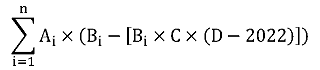
  •  (1) Subject to subsection (2) and sections 16, 36.1, 36.2 and 42, the person responsible for a covered facility, other than an electricity generation facility, must determine the GHG emissions limit that applies to that covered facility for each compliance period, expressed in CO2e tonnes, in accordance with the formula

    The summation of the products of Ai and the result of Bi minus the product of Bi, C and D minus 2022 for each specified industrial activity “i”.

    where

    Ai
    is the covered facility’s production from each specified industrial activity “i” during the compliance period, quantified in accordance with section 31;
    Bi
    is the following output-based standard applicable to the specified industrial activity “i”, as the case may be:
    • (a) for a specified industrial activity set out in column 1 of Schedule 1 and for which an output-based standard is set out in column 3 of that Schedule, that standard,

    • (b) for a specified industrial activity set out in column 1 of Schedule 1 and for which column 3 of that Schedule sets out that an output-based standard must be calculated in accordance with section 37, the output-based standard calculated in accordance with that section, and

    • (c) for an additional industrial activity, the output-based standard calculated in accordance with section 37;

    C
    is the following tightening rate applicable to the specified industrial activity “i”, as the case may be:
    • (a) 0% for the specified industrial activity set out in item 38, column 1, of Schedule 1,

    • (b) 1% for the specified industrial activities set out in paragraph 3(c) and items 7, 8, 13, 17, 19, 20, 34, 40, 41 and 43, column 1, of Schedule 1, and

    • (c) 2% for all other specified industrial activities;

    D
    is the calendar year that corresponds to the compliance period; and
    i
    is the ith specified industrial activity where “i” goes from 1 to n and where n is the total number of specified industrial activities engaged in at the covered facility.
  • Marginal note:Ethanol production

    (2) For the purposes of subsection (1), the person responsible for a covered facility must not include the specified industrial activity set out in paragraph 13(b), column 1, of Schedule 1 unless the covered facility also includes the specified industrial activity set out in paragraph 13(a), column 1. The covered facility is deemed to not be engaged in the specified industrial activity set out in item 32, column 1, of that Schedule.

  • Marginal note:Oilseeds

    (3) For the purposes of subsection (1), the person responsible for a covered facility where the specified industrial activity set out in item 31, column 1, of Schedule 1 is engaged in may, for the 2019 calendar year, quantify their production in finished oilseed products and use an output-based standard of 0.0431 CO2e tonnes per unit of measurement of production, instead of the production metric set out in column 2 and the output-based standard set out in column 3.

  • Marginal note:Clarification — fertilizer

    (4) For greater certainty, if the industrial activity set out in paragraph 29(b), column 1, of Schedule 1 and also any of the industrial activities set out in paragraph 29(c), (d) or (e), column 1, of Schedule 1 are engaged in at the covered facility, the output-based standard applicable to the industrial activity set out in that paragraph 29(b) applies and the output-based standard applicable to the industrial activity set out in that paragraph 29(c), (d) or (e) applies, as the case may be.

  • Marginal note:New additional industrial activity

    (4.1) For the purposes of subsection (1), an additional industrial activity that was recognized by the Minister during a calendar year is not included in the determination of the GHG emissions limit for the compliance period that corresponds to that calendar year.

  • Marginal note:Output-based standard

    (5) For the purposes of subsection (1), if an output-based standard must be calculated, it is calculated once, except in the situation referred to in subsection 39.

  • SOR/2023-240, s. 23
.

Marginal note:New electricity production — gaseous fuel

  •  (1) Despite subsection 36(1), if a covered facility — other than one referred to in subsection 16(6) — begins generating electricity on or after January 1, 2021 and meets the following criteria, the person responsible for the covered facility must apply, for the specified industrial activity set out in paragraph 38(c), column 1, of Schedule 1, the applicable output-based standard, in accordance with subsection (2), for each compliance period, as of the compliance period during which the covered facility began generating electricity:

    • (a) the electricity is generated from gaseous fuel by equipment that is designed to operate at a thermal energy to electricity ratio of less than 0.9; and

    • (b) the covered facility has an electricity generation capacity equal to or greater than 50 MW from that equipment.

  • Marginal note:Decreasing output-based standard

    (2) The output-based standard that applies to the industrial activity referred to in paragraph 38(c), column 1, of Schedule 1 is, as the case may be

    • (a) 370 CO2e tonnes per unit of measurement, for the 2021 compliance period,

    • (b) 329 CO2e tonnes per unit of measurement, for the 2022 compliance period,

    • (c) 288 CO2e tonnes per unit of measurement, for the 2023 compliance period,

    • (d) 247 CO2e tonnes per unit of measurement, for the 2024 compliance period,

    • (e) 206 CO2e tonnes per unit of measurement, for the 2025 compliance period,

    • (f) 164 CO2e tonnes per unit of measurement, for the 2026 compliance period,

    • (g) 123 CO2e tonnes per unit of measurement, for the 2027 compliance period,

    • (h) 82 CO2e tonnes per unit of measurement, for the 2028 compliance period,

    • (i) 41 CO2e tonnes per unit of measurement, for the 2029 compliance period, and

    • (j) 0 CO2e tonnes per unit of measurement, for the 2030 compliance period and subsequent compliance periods.

Marginal note:Increased capacity of electricity generation

  •  (1) Subject to subsections 16(1) to (5) and (7) to (10), if, on or after January 1, 2021, a covered facility — other than a covered facility referred to in subsection 16(6) — increases its electricity generation capacity from gaseous fuels by 50 MW or more and that increased capacity is from equipment that has a thermal energy to electricity ratio of less than 0.9 and that was added after that date or has had its capacity increased and, the person responsible for the covered facility must determine the covered facility’s GHG emissions limit for each compliance period, as of the compliance period during which the increase occurred, in accordance with subsection (2).

  • Marginal note:Different output-based standard

    (2) The GHG emissions limit that applies to the covered facility for a compliance period, expressed in CO2e tonnes, is determined in accordance with the formula

    The summation of the products of Ai and the result of Bi minus the product of Bi, C and D minus 2022 for each specified industrial activity “i”, plus the summation of the products of E and F and the products of G and F and the products of H and I.

    where

    Ai
    is the covered facility’s production during the compliance period, quantified in accordance with section 31,
    • (a) from each specified industrial activity “i”, except the industrial activity set out in paragraph 38(c), column 1, of Schedule 1, and

    • (b) from the specified industrial activity set out in paragraph 38(c), column 1, of Schedule 1, other than from equipment referred to in the descriptions of E, G and H;

    Bi
    is the following output-based standard applicable to the specified industrial activity “i”, as the case may be:
    • (a) for a specified industrial activity set out in column 1 of Schedule 1 and for which an output-based standard is set out in column 3 of that Schedule, that standard,

    • (b) for a specified industrial activity set out in column 1 of Schedule 1 and for which column 3 of that Schedule sets out that an output-based standard must be calculated in accordance with section 37, the output-based standard calculated in accordance with that section, and

    • (c) for an additional industrial activity, the output based standard calculated in accordance with section 37;

    C
    is the following tightening rate applicable to the specified industrial activity “i”, as the case may be:
    • (a) 0% for the specified industrial activity set out in item 38, column 1, of Schedule 1,

    • (b) 1% for the specified industrial activities set out in paragraph 3(c) and items 7, 8, 13, 17, 19, 20, 34, 40, 41 and 43, column 1, of Schedule 1, and

    • (c) 2% for all other specified industrial activities;

    D
    is the calendar year that corresponds to the compliance period;
    E
    is the gross amount of electricity generated during the compliance period by the equipment that started generating electricity from gaseous fuels on or after January 1, 2021, and is designed to operate at a thermal energy to electricity ratio of less than 0.9, from the specified industrial activity set out in paragraph 38(c), column 1, of Schedule 1, quantified in accordance with section 31;
    F
    is the output-based standard set out in subsection 36.1(2) that is applicable for the compliance period;
    G
    is, for equipment with increased electricity generation capacity and a thermal energy to electricity ratio of less than 0.9, other than equipment referred to in the description of E, the gross amount of electricity generated during the compliance period attributed to the capacity added to the equipment, from the specified industrial activity set out in paragraph 38(c), column 1, of Schedule 1, quantified in accordance with section 31 and subsection (3);
    H
    is, for equipment with increased electricity generation capacity and a thermal energy to electricity ratio of less than 0.9, other than equipment referred to in the description of E, the gross amount of electricity generated during the compliance period attributed to the capacity of the equipment before the additional capacity was added, from the specified industrial activity set out in paragraph 38(c), column 1, of Schedule 1, quantified in accordance with section 31 and subsection (3);
    I
    is the output-based standard set out in item 38, column 3, of Schedule 1 that is applicable to the specified industrial activity set out in paragraph 38(c), column 1 of that Schedule; and
    i
    is the ith specified industrial activity where “i” goes from 1 to n and where n is the total number specified industrial activities engaged in at the covered facility.
  • Marginal note:Apportionment of electricity generation

    (3) For the purposes of the descriptions of G and H in subsection (2), the gross amount of electricity generated by the equipment referred to in those descriptions is apportioned, using engineering estimates, to the equipment’s capacity added to the equipment and to the capacity of the equipment before the additional capacity was added, based on the ratio of the amount of its increased capacity to its total capacity, taking into account the increased capacity.

  • Marginal note:Increased capacity — rule

    (4) For the purposes of subsection (1), the electricity generation capacity of a facility increases by 50 MW or more for a calendar year as of the day on which its electricity generation capacity is 50 MW greater than its electricity generation capacity on December 31, 2020. For greater certainty, any increase in capacity is cumulative.

  • SOR/2023-240, s. 24
.

Marginal note:Presumption

 If the output-based standard set out in subsection 36.1(2) applies to a covered facility’s generation of electricity for a given compliance period, it continues to apply for all subsequent compliance periods even if

  • (a) for the purposes of section 36.1, the covered facility is not generating electricity from gaseous fuel or the equipment in question has a thermal energy to electricity ratio that is equal to or greater than 0.9; or

  • (b) for the purposes of section 36.2, the equipment in question is not generating electricity from gaseous fuel or has a thermal energy to electricity ratio that is equal to or greater than 0.9.

Marginal note:Calculated output-based standard

  •  (1) Subject to subsection (3) and sections 38 and 39, the output-based standard that is applicable to a specified industrial activity of a covered facility, for which an output-based standard must be calculated in accordance with this section, is calculated in accordance with the formula

    The quotient where the numerator is the summation of A minus the result of the summation of B, C and F minus G for each reference year “i”, and the denominator is the summation of D for each reference year “i”, and then the quotient is multiplied by E.

    where

    A
    is the quantity of GHGs that are emitted from the covered facility for reference year “i”, determined in accordance with section 35, expressed in CO2e tonnes;
    B
    is the allocation for net thermal energy for reference year “i” and is
    • (a) determined by the formula

      0.062 CO2e tonnes/gigajoules × (M − N) × O

      where

      M
      is the quantity of thermal energy produced by the covered facility that was sold to another covered facility in reference year “i”, as indicated by the quantity of thermal energy on sales receipts or determined by another objective method, expressed in gigajoules,
      N
      is the quantity of thermal energy that was bought from other covered facilities and not subsequently sold in reference year “i”, as indicated by the quantity of thermal energy on sales receipts or by another objective method, expressed in gigajoules, and
      O
      is the ratio of heat from the combustion of fossil fuels to produce thermal energy and is,
      • (i) if M is greater than N, the ratio of heat determined under section 34 for reference year “i” for the covered facility, or

      • (ii) if M is less than N, the ratio of heat determined under section 34 for reference year “i” for the covered facility from which the thermal energy was purchased, and

    • (b) 0 for all reference years if the absolute value of the quotient obtained by dividing the sum of the results determined under paragraph (a) for each reference year “i” by the number of reference years is less than the quotient determined by the formula

      The product of 0.015 by the quotient where the numerator is the sum of A for each reference year “i” and the denominator is n.
    C
    is the total quantity of GHGs from all specified industrial activities engaged in at the facility for reference year “i” other than the industrial activity for which the output-based standard is being calculated, determined in accordance with sections 17 and 18;
    D
    is the production from a covered facility from the specified industrial activity for which the output-based standard is being calculated for reference year “i” quantified in accordance with section 31;
    E
    is the GHG emissions reduction factor applicable to the specified industrial activity for which the output-based standard is being calculated and is
    • (a) 95% for a specified industrial activity set out in paragraph 7(c), 8(b) or (c) or 20(d), column 1, of Schedule 1,

    • (b) 90% for a specified industrial activity set out in item 22 or paragraph 23(a) or 29(d), column 1, of Schedule 1, and

    • (c) 80% for all other specified industrial activities;

    F
    is the total quantity of GHGs from an activity engaged in at the facility, for reference year “i”, that is not a specified industrial activity, determined in accordance with sections 17 and 18, if
    • (a) with respect to a covered facility whose primary activity is an industrial activity,

      • (i) that quantity accounts for 20% or more of the total quantity of GHGs from a covered facility for that reference year, determined in accordance with sections 17 and 18, or

      • (ii) the revenue, in dollars, attributable to the sale of the product produced by the facility from that industrial activity accounts for 20% or more of the revenue, in dollars, attributable to the sale of all products produced by the facility from all of the facility’s industrial activities for that reference year, or

    • (b) with respect to a covered facility whose primary activity is not an industrial activity,

      • (i) the activity is not an industrial activity, or

      • (ii) the quantity of GHGs from an industrial activity accounts for 20% or more of the total quantity of GHGs from a covered facility, for that reference year, determined in accordance with sections 17 and 18; and

    G
    is the quantity of CO2 determined for the purposes of the description B in section 35, from all activities engaged in at the facility for reference year “i” other than the industrial activity for which the output-based standard is being calculated; and
    i
    is the ith reference year, where “i” goes from 1 to n and where n is the number of reference years, determined in accordance with subsection (2).
  • Marginal note:Reference years

    (2) Subject to paragraph (2.1)(a), the reference years applicable to the specified industrial activities that are engaged in at a covered facility for which an emissions limit is calculated for a compliance period are

    • (a) except for a covered facility referred to in paragraph (b),

      • (i) the 2017, 2018 and 2019 calendar years, if the data are available for those years,

      • (ii) the three calendar years preceding the compliance period, if the data are not available for the 2017, 2018, and 2019 calendar years, or

      • (iii) the compliance period, if the data are not available for the years specified in subparagraphs (i) and (ii); and

    • (b) for a covered facility for which an emissions limit is being calculated for the first time but for which the person responsible has submitted an annual report under these Regulations for a previous compliance period without including the information referred to in paragraphs 11(1)(e) and (f) in accordance with subsection 11(2), either

      • (i) the two calendar years preceding the compliance period for which the emissions limit is calculated, if the data are available for those years,

      • (ii) the calendar year preceding the compliance period for which the emissions limit is calculated, if the data are not available for the two calendar years referred to in (i), or

      • (iii) the compliance period for which the emissions limit is being calculated, if that data are not available for those preceding calendar years.

  • Marginal note:New activity

    (2.1) For the purposes of subsection (1), if the calculation of the emissions limit for a compliance period takes into account a specified industrial activity that began to be engaged in at the covered facility during that compliance period and for which an output-based standard has not previously been calculated under this section

    • (a) the applicable reference years with respect to that specified industrial activity are that compliance period and the two calendar years following it; and

    • (b) the determination of the output-based standard for that specified industrial activity is to be made based on projections, made using engineering estimates, for the applicable reference years.

  • Marginal note:Attributing of emissions

    (2.2) For the purposes of the descriptions of C, F and G in subsection (1), the method used to attribute the quantity of GHGs to an activity must be rigourous, objective and based on sound engineering principles. The same method must be used for each reference year and no quantity of GHGs may be attributed to more than one activity.

  • Marginal note:Thermal energy allocation

    (3) For the purposes of subsection (1), if an output-based standard must be calculated with respect to a covered facility for more than one specified industrial activity, the allocation for net thermal energy can only be deducted from one of those calculations.

  • Marginal note:Rounding

    (4) The result from the calculation under subsection (1) is rounded to three significant figures.

  • SOR/2021-197, s. 13
  • SOR/2023-240, s. 25
.

Marginal note:Exception — steel

  •  (1) For the purposes of the description of C in subsection 37(1), if the specified industrial activity for which the output-based standard is being calculated is the industrial activity set out in paragraph 20(d), column 1, of Schedule 1 and the covered facility is also engaged in the generation of electricity, the quantity of GHGs from the generation of electricity attributable to the industrial activity set out in that item are not included in the total quantity of GHGs determined for C.

  • Marginal note:For greater certainty

    (2) For greater certainty, the quantity of GHGs from the generation of electricity attributable to the specified industrial activities set out in paragraphs 20(a) to (c), column 1, of Schedule 1 are included in the total quantity of emissions determined for C.

Marginal note:Recalculation of output-based standard

 If an output-based standard applicable to a specified industrial activity was calculated in accordance with subsection 37(2.1) for a compliance period, it must be recalculated in accordance with subsection 37(1) for the third compliance period following the compliance period for which the original calculation was done. The reference years that must be used for the recalculation are the three calendar years that precede that third compliance period.

  • SOR/2023-240, s. 26
.

 [Repealed, SOR/2023-240, s. 27]

Marginal note:Electricity

  •  (1) Subject to subsection (2) and sections 41.1 and 41.2, the person responsible for an electricity generation facility must determine the GHG emissions limit that applies to the electricity generation facility for each compliance period, expressed in CO2e tonnes, in accordance with the formula

    The summation of the products of Aj and Bj for each industrial activity referred to in paragraphs 38(a) to (c) of Schedule 1 “j”, summed for each unit “i” within the facility

    where

    Aj
    is the gross amount of electricity generated during the compliance period quantified in accordance with section 32, for each unit “i” within the electricity generation facility, from each of the industrial activities set out in paragraphs 38(a) to (c), column 1, of Schedule 1 that is engaged in at the electricity generation facility;
    Bj
    is the output-based standard applicable to each specified industrial activity set out in paragraphs 38(a) to (c), column 1, of Schedule 1 that are engaged in at each unit “i” and that is set out in column 3;
    i
    is the ith unit, where “i” goes from 1 to n and where n is the total number of units within the electricity generation facility generating electricity using fossil fuels; and
    j
    is the jth activity, where “j” goes from 1 to m and where m is the total number of industrial activities set out in paragraphs 38(a) to (c), column 1, of Schedule 1 that are engaged in at the facility.
  • Marginal note:Output-based standard — exception

    (2) The output-based standard applicable to the industrial activity set out in paragraph 38(a), column 1, of Schedule 1 applies to a boiler unit if it generates electricity using liquid or gaseous fuel and it

    • (a) is registered under the Reduction of Carbon Dioxide Emissions from Coal-fired Generation of Electricity Regulations, or it was at any given time in 2018; and

    • (b) used solid fuel to generate electricity in 2018.

  • SOR/2021-197, s. 14
.

Marginal note:New electricity production facility — gaseous fuel

  •  (1) If an electricity generation facility begins generating electricity on or after January 1, 2021 and meets the following criteria, the person responsible for the covered facility must determine the GHG emissions limit that applies to the facility for each compliance period as of the compliance period during which the electricity generation began, in accordance with subsection (2):

    • (a) at least one unit within the facility generates electricity from gaseous fuels; and

    • (b) at least one of the units that generates electricity from gaseous fuels within the facility has an electricity generation capacity equal to or greater than 50 MW and is designed to operate at a thermal energy to electricity ratio of less than 0.9.

  • Marginal note:Different output-based standard

    (2) The GHG emissions limit that applies to the electricity generation facility, expressed in CO2e tonnes, is determined for each compliance period in accordance with the formula

    The summation of the products of Aj and Bj for each industrial activity referred to in paragraphs 38(a) to (c) of Schedule 1 “j”, summed for each unit “i” within the facility, plus the summation of the products of C and D, summed for each unit “k” within the facility, plus the summation of the products of E and F, summed for each unit “l” within the facility

    where

    Aj
    is, for each unit “i” within the electricity generation facility that generates electricity from solid fuel or liquid fuel, the gross amount of electricity generated during the compliance period, quantified in accordance with section 32, from the specified industrial activities set out in paragraph 38(a) and (b), column 1, of Schedule 1 that are engaged in at the unit;
    Bj
    the output-based standard applicable to each specified industrial activity set out in paragraphs 38(a) and (b), column 1, of Schedule 1 that the are engaged in at each unit “i” and that is set out in column 3;
    C
    is, for each unit “k” within the electricity generation facility that generates electricity from gaseous fuels, that has an electricity generation capacity equal to or greater than 50 MW and that is designed to operate at a thermal energy to electricity ratio of less than 0.9, the gross amount of electricity generated during the compliance period from the specified industrial activity set out in paragraph 38(c), column 1, of Schedule 1 that is engaged in at the unit quantified in accordance with section 32;
    D
    is the output-based standard applicable and is
    • (a) 370 CO2e tonnes per unit of measurement, for compliance period 2021,

    • (b) 329 CO2e tonnes per unit of measurement, for compliance period 2022,

    • (c) 288 CO2e tonnes per unit of measurement, for compliance period 2023,

    • (d) 247 CO2e tonnes per unit of measurement, for compliance period 2024,

    • (e) 206 CO2e tonnes per unit of measurement, for compliance period 2025,

    • (f) 164 CO2e tonnes per unit of measurement, for compliance period 2026,

    • (g) 123 CO2e tonnes per unit of measurement, for compliance period 2027,

    • (h) 82 CO2e tonnes per unit of measurement, for compliance period 2028,

    • (i) 41 CO2e tonnes per unit of measurement, for compliance period 2029, and

    • (j) 0 CO2e tonnes per unit of measurement, for compliance period 2030 and subsequent compliance periods; and

    E
    is, for each unit “l” within the electricity generation facility generating electricity from gaseous fuels, that has an electricity generation capacity of less than 50 MW or is designed to operate at a thermal energy to electricity ratio of 0.9 or greater, the gross amount of electricity generated during the compliance period from the specified industrial activity set out in paragraph 38(c), column 1, of Schedule 1, that is engaged in at the unit quantified in accordance with section 32;
    F
    the output-based standard applicable to each specified industrial activity set out in paragraph 38(c), column 1, of Schedule 1 that are engaged in at each unit “i” and that is set out in column 3;
    i
    is the ith unit, where “i” goes from 1 to n and where n is the total number of units within the electricity generation facility generating electricity using solid fuel or liquid fuel;
    j
    is the jth activity, where “j” goes from 1 to m and where m is the total number of industrial activities set out in paragraphs 38(a) to (b), column 1, of Schedule 1 that is engaged in at the electricity generation facility;
    k
    is the kth unit, where “k” goes from 1 to r and where r is the total number of units within the electricity generation facility, generating electricity using gaseous fuel, that have an electricity generation capacity equal to or greater than 50 MW and are designed to operate at a thermal energy to electricity ratio of less than 0.9;
    l
    is the lth unit, where “l” goes from 1 to s and where s is the total number of units within the electricity generation facility, generating electricity using gaseous fuel, that have an electricity generation capacity of less than 50 MW or are designed to operate at a thermal energy to electricity ratio of 0.9 or greater.
  • SOR/2021-197, s. 15
.

Marginal note:Increased capacity of electricity generation

  •  (1) If, on or after January 1, 2021, an electricity generation facility’s electricity generation capacity from gaseous fuels increases by 50 MW or more and that increased capacity is from a unit designed to operate at a thermal energy to electricity ratio of less than 0.9, the person responsible for the covered facility must determine the GHG emissions limit that applies to the facility for each compliance period, as of the compliance period during which the increase occurred, in accordance with subsection (2).

  • Marginal note:Different output-based standard

    (2) The GHG emissions limit that applies to the electricity generation facility, expressed in CO2e tonnes, is determined for each compliance period in accordance with the formula

    The summation of the products of Aj and Bj for each industrial activity referred to in paragraphs 38(a) to (c) of Schedule 1 “j”, summed for each unit “i” within the facility, plus the summation of the products of C and D, summed for each unit “k” within the facility, plus the summation of the products of E and D plus the products of F and G, summed for each unit “l” within the facility

    where

    Aj
    is the gross amount of electricity generated during the compliance period, quantified in accordance with section 32, for each of the following units:
    • (a) for each unit “i” within the electricity generation facility, from each of the specified industrial activities set out in paragraphs 38(a) and (b), column 1, of Schedule 1 that are engaged in at the electricity generation facility,

    • (b) from the specified industrial activity set out in paragraph 38(c), column 1, of Schedule 1 that is engaged in at the unit, for each unit “i” within an electricity generation facility that

      • (i) was generating electricity prior to the facility’s increase in electricity generation capacity, except units referred to in the description of E or F, and

      • (ii) that began generating electricity on or after January 1, 2021, if the unit has an electricity generation capacity of less than 50 MW or designed to operate at a thermal energy to electricity ratio equal to or greater than 0.9;

    Bj
    the output-based standard applicable to each of the specified industrial activities set out in paragraphs 38(a) to (c), column 1, of Schedule 1 that are engaged in at each unit “i” and that is set out in column 3;
    C
    is, for each unit “k” within the electricity generation facility that started generating electricity from gaseous fuels on or after January 1, 2021, that has an electricity generation capacity equal to or greater than 50 MW and that is designed to operate at a thermal energy to electricity ratio of less than 0.9, the gross amount of electricity generated during the compliance period from the specified industrial activity set out in paragraph 38(c), column 1, of Schedule 1 that is engaged in at the unit quantified in accordance with section 32;
    D
    is the output-based standard set out in the description of D in subsection 41.1(2) that is applicable to the compliance period in question;
    E
    is, for each unit “l” that generated electricity from gaseous fuels within the electricity generation facility prior to the facility’s increase in electricity generation capacity and whose electricity generation capacity was increased by 50 MW or more and that is designed to operate at a thermal energy to electricity ratio of less than 0.9, the gross amount of electricity generated during the compliance period that is attributed to the capacity added to a unit, from the specified industrial activity set out in paragraph 38(c), column 1, of Schedule 1 that is engaged in at the unit, quantified in accordance with section 32 and subsection (3);
    F
    is, for each unit “l” that generated electricity from gaseous fuels within the electricity generation facility prior to the facility’s increase in electricity generation capacity and whose electricity generation capacity was increased by 50 MW or more and that is designed to operate at a thermal energy to electricity ratio of less than 0.9, the gross amount of electricity generated during the compliance period that is attributed to the capacity of the unit before the additional capacity was added, from the specified industrial activity set out in paragraph 38(c), column 1, of Schedule 1, that is engaged in at the unit, quantified in accordance with section 32 and subsection (3);
    G
    is the output-based standard applicable to the specified industrial activity set out in paragraph 38(c), column 1, of Schedule 1 and set out in column 3;
    i
    is the ith unit, where “i” goes from 1 to n and where n is the total number of units within the electricity generation facility generating electricity using fossil fuels, except units referred to in the description of k and l;
    j
    is the jth activity, where “j” goes from 1 to m and where m is the total number of industrial activities set out in paragraphs 38(a) to (c), column 1, of Schedule 1 that are engaged in at the electricity generation facility;
    k
    is the kth unit, where “k” goes from 1 to r and where r is the total number of units within the electricity generation facility that started generating electricity from gaseous fuels on or after January 1, 2021, that have an electricity generation capacity equal to or greater than 50 MW and that are designed to operate at a thermal energy to electricity ratio of less than 0.9; and
    l
    is the lth unit, where “l” goes from 1 to s and where s is the total number of units that generated electricity from gaseous fuels within the electricity generation facility prior to the facility’s increase in electricity generation capacity and whose electricity generation capacity was increased by 50 MW or more and that are designed to operate at a thermal energy to electricity ratio of less than 0.9.
  • Marginal note:Apportionment of electricity generation

    (3) For the purposes of the descriptions of E and F in subsection (2), the gross amount of electricity generated by a unit referred to those descriptions is apportioned, using engineering estimates, to the capacity added to the unit and to the capacity of the unit before the additional capacity was added, based on the ratio of its increased capacity to its total capacity, taking into account the increased capacity.

  • Marginal note:Increased capacity — rule

    (4) For the purposes of subsection (1), the electricity generation capacity, from gaseous fuels, of an electricity generation facility increases by 50 MW or more for a calendar year as of the day on which its electricity generation capacity is 50 MW greater than its electricity generation capacity on December 31, 2020. For greater certainty, any increase in a unit’s capacity is cumulative.

  • SOR/2021-197, s. 16
.
Loading…